Ch.10 - Gases
Brown - Chemistry: The Central Science 15th Edition
Brown15th EditionChemistry: The Central ScienceISBN: 9780137542970당신이 사용하는 게 아니라요?교과서 변경
10장, 문제 52

Calculate the molar mass of a vapor that has a density of 7.135 g/L at 12°C and 743 torr.

검증된 단계별 안내
1
Convert the temperature from Celsius to Kelvin using the formula: \( T(K) = T(°C) + 273.15 \).
Convert the pressure from torr to atm using the conversion factor: \( 1 \text{ atm} = 760 \text{ torr} \).
Use the ideal gas law equation in the form \( PV = nRT \) to solve for the molar mass \( M \). Rearrange it to \( M = \frac{dRT}{P} \), where \( d \) is the density, \( R \) is the ideal gas constant (0.0821 L·atm/mol·K), \( T \) is the temperature in Kelvin, and \( P \) is the pressure in atm.
Substitute the values for density, \( R \), temperature in Kelvin, and pressure in atm into the rearranged ideal gas law equation.
Calculate the molar mass using the substituted values.

비슷한 문제에 대한 검증된 영상 답변:

이 영상 해법은 위 문제에 도움이 된다고 튜터들이 추천한 것입니다.
영상 길이:
3m

주요 개념

질문에 올바르게 답하기 위해 반드시 이해해야 하는 핵심 개념들은 다음과 같습니다.

Ideal Gas Law

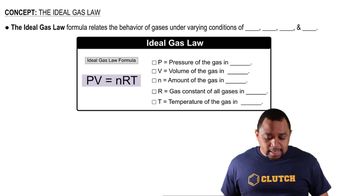
The Ideal Gas Law relates the pressure, volume, temperature, and number of moles of a gas through the equation PV = nRT. This law is essential for understanding how gases behave under different conditions and is used to derive relationships between density, molar mass, and other properties of gases.
추천 영상:
가이드 코스
01:15
Ideal Gas Law Formula

Density of Gases

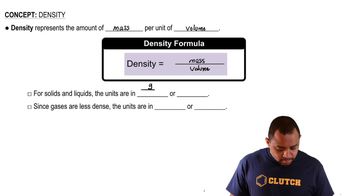
Density is defined as mass per unit volume. For gases, density can be influenced by temperature and pressure. The density of a gas can be used in conjunction with the Ideal Gas Law to calculate molar mass, as it provides a direct relationship between the mass of the gas and its volume under specific conditions.
추천 영상:
가이드 코스
01:56
Density Concepts

Molar Mass Calculation

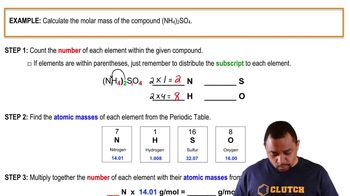
Molar mass is the mass of one mole of a substance, typically expressed in grams per mole (g/mol). To calculate the molar mass of a vapor using its density, temperature, and pressure, one can rearrange the Ideal Gas Law to find the molar mass in terms of these variables, allowing for the determination of the substance's identity.
추천 영상:
가이드 코스
03:12
Molar Mass Calculation Example
관련 실천
교과서 질문

Magnesium can be used as a “getter” in evacuated enclosures to react with the last traces of oxygen. (The magnesium is usually heated by passing an electric current through a wire or ribbon of the metal.) If an enclosure of 0.452 L has a partial pressure of O2 of 3.5×10⁻⁶ torr at 27°C, what mass of magnesium will react according to the following equation?

1
views
교과서 질문

Which of the following statements best explains why a closed balloon filled with helium gas rises in air? (a) Helium is a monatomic gas, whereas nearly all the molecules that make up air, such as nitrogen and oxygen, are diatomic. (b) The average speed of helium atoms is greater than the average speed of air molecules, and the greater speed of collisions with the balloon walls propels the balloon upward. (c) Because the helium atoms are of lower mass than the average air molecule, the helium gas is less dense than air. The mass of the balloon is thus less than the mass of the air displaced by its volume. (d) Because helium has a lower molar mass than the average air molecule, the helium atoms are in faster motion. This means that the temperature of the helium is greater than the air temperature. Hot gases tend to rise.

1663
views
교과서 질문

(a) Calculate the density of NO2 gas at 0.970 atm and 35 °C.

559
views
교과서 질문

In the Dumas-bulb technique for determining the molar mass of an unknown liquid, you vaporize the sample of a liquid that boils below 100°C in a boiling-water bath and determine the mass of vapor required to fill the bulb. From the following data, calculate the molar mass of the unknown liquid: mass of unknown vapor, 1.012 g; volume of bulb, 354 cm3; pressure, 742 torr; temperature, 99°C.

교과서 질문

(b) Calculate the molar mass of a gas if 2.50 g occupies 0.875 L at 685 torr and 35 °C

977
views