


Ch.10 - Gases
Brown - Chemistry: The Central Science 15th Edition
Brown15th EditionChemistry: The Central ScienceISBN: 9780137542970당신이 사용하는 게 아니라요?교과서 변경
10장, 문제 116a

Natural gas is very abundant in many Middle Eastern oil fields. However, the costs of shipping the gas to markets in other parts of the world are high because it is necessary to liquefy the gas, which is mainly methane and has a boiling point at atmospheric pressure of −164°C. One possible strategy is to oxidize the methane to methanol, CH3OH, which has a boiling point of 65°C and can therefore be shipped more readily. Suppose that 10.7×109 ft3 of methane at atmospheric pressure and 25°C is oxidized to methanol. a. What volume of methanol is formed if the density of CH3OH is 0.791 g/mL?

검증된 단계별 안내
1
Step 1: Convert the volume of methane from cubic feet to liters.
Step 2: Use the ideal gas law to calculate the number of moles of methane. The ideal gas law is given by PV = nRT, where P is pressure, V is volume, n is the number of moles, R is the ideal gas constant, and T is temperature in Kelvin.
Step 3: Write the balanced chemical equation for the oxidation of methane to methanol: CH4 + 1/2 O2 -> CH3OH. From the equation, note that 1 mole of CH4 produces 1 mole of CH3OH.
Step 4: Calculate the number of moles of methanol produced, which is equal to the number of moles of methane reacted.
Step 5: Convert the moles of methanol to volume using the density of methanol. Use the formula: Volume = Mass / Density, where Mass = moles * molar mass of CH3OH.

비슷한 문제에 대한 검증된 영상 답변:

이 영상 해법은 위 문제에 도움이 된다고 튜터들이 추천한 것입니다.
영상 길이:
8m

주요 개념

질문에 올바르게 답하기 위해 반드시 이해해야 하는 핵심 개념들은 다음과 같습니다.

Ideal Gas Law

The Ideal Gas Law relates the pressure, volume, temperature, and number of moles of a gas through the equation PV = nRT. This law is essential for converting the volume of methane gas at given conditions into moles, which can then be used to determine the amount of methanol produced after the oxidation reaction.
추천 영상:
가이드 코스
01:15
Ideal Gas Law Formula

Stoichiometry

Stoichiometry involves the calculation of reactants and products in chemical reactions based on balanced chemical equations. Understanding stoichiometry is crucial for determining the amount of methanol produced from the oxidation of methane, as it allows for the conversion of moles of methane to moles of methanol using the reaction's coefficients.
추천 영상:
가이드 코스
01:16
Stoichiometry Concept

Density and Volume Conversion

Density is defined as mass per unit volume and is a key factor in converting between mass and volume. In this context, knowing the density of methanol allows for the calculation of the volume of methanol produced from its mass, which is derived from the stoichiometric calculations of the oxidation reaction.
추천 영상:
가이드 코스
05:30
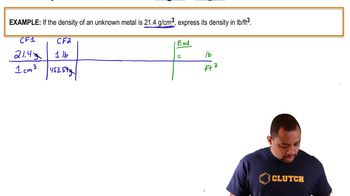
Density Conversion Example
관련 실천
교과서 질문

Gaseous iodine pentafluoride, IF5, can be prepared by the reaction of solid iodine and gaseous fluorine: I2(s) + 5 F2(g) → 2 IF5(g) A 5.00-L flask containing 10.0 g of I2 is charged with 10.0 g of F2, and the reaction proceeds until one of the reagents is completely consumed. After the reaction is complete, the temperature in the flask is 125 °C.  (c) Draw the Lewis structure of IF5.

992
views
교과서 질문

Ammonia and hydrogen chloride react to form solid ammonium chloride: NH31g2 + HCl1g2¡NH4Cl1s2 Two 2.00-L flasks at 25 °C are connected by a valve, as shown in the drawing. One flask contains 5.00 g of NH31g2, and the other contains 5.00 g of HCl(g). When the valve is opened, the gases react until one is completely consumed. (a) Which gas will remain in the system after the reaction is complete?

882
views
교과서 질문

Ammonia and hydrogen chloride react to form solid ammonium chloride: NH3(g) + HCl(g) → NH4Cl(s)

Two 2.00-L flasks at 25 °C are connected by a valve, as shown in the drawing. One flask contains 5.00 g of NH3(g), and the other contains 5.00 g of HCl(g). When the valve is opened, the gases react until one is completely consumed. (b) What will be the final pressure of the system after the reaction is complete? (Neglect the volume of the ammonium chloride formed.)

4501
views
교과서 질문

Gaseous iodine pentafluoride, IF5, can be prepared by the reaction of solid iodine and gaseous fluorine: I2(s) + 5 F2(g) → 2 IF5(g) A 5.00-L flask containing 10.0 g of I2 is charged with 10.0 g of F2, and the reaction proceeds until one of the reagents is completely consumed. After the reaction is complete, the temperature in the flask is 125 °C. (d) What is the total mass of reactants and products in the flask?

1483
views
교과서 질문

Gaseous iodine pentafluoride, IF5, can be prepared by the reaction of solid iodine and gaseous fluorine: I2(s) + 5 F2(g) → 2 IF5(g) A 5.00-L flask containing 10.0 g of I2 is charged with 10.0 g of F2, and the reaction proceeds until one of the reagents is completely consumed. After the reaction is complete, the temperature in the flask is 125 °C. (a) What is the partial pressure of IF5 in the flask?

982
views