

Ch.10 - Gases
Brown - Chemistry: The Central Science 15th Edition
Brown15th EditionChemistry: The Central ScienceISBN: 9780137542970당신이 사용하는 게 아니라요?교과서 변경
10장, 문제 99

Nickel carbonyl, Ni(CO)4, is one of the most toxic substances known. The present maximum allowable concentration in laboratory air during an 8-h workday is 1 ppb (parts per billion) by volume, which means that there is one mole of Ni(CO)4 for every 109 moles of gas. Assume 24°C and 1.00 atm pressure. What mass of Ni(CO)4 is allowable in a laboratory room that is 12ft×20ft×9ft?

검증된 단계별 안내
1
Convert the room dimensions from feet to meters to calculate the volume in cubic meters. Use the conversion factor: 1 ft = 0.3048 m.
Calculate the volume of the room in cubic meters using the formula: \( \text{Volume} = \text{length} \times \text{width} \times \text{height} \).
Use the ideal gas law, \( PV = nRT \), to find the total number of moles of gas in the room. Use \( P = 1.00 \text{ atm} \), \( R = 0.0821 \text{ L atm mol}^{-1} \text{ K}^{-1} \), and convert the temperature to Kelvin.
Determine the number of moles of Ni(CO)_4 using the given concentration of 1 ppb, which means 1 mole of Ni(CO)_4 per 10^9 moles of air.
Calculate the mass of Ni(CO)_4 using its molar mass (\( M_{\text{Ni(CO)}_4} = 170.73 \text{ g/mol} \)) and the number of moles of Ni(CO)_4 found in the previous step.

비슷한 문제에 대한 검증된 영상 답변:

이 영상 해법은 위 문제에 도움이 된다고 튜터들이 추천한 것입니다.
영상 길이:
3m

주요 개념

질문에 올바르게 답하기 위해 반드시 이해해야 하는 핵심 개념들은 다음과 같습니다.

Ideal Gas Law

The Ideal Gas Law relates the pressure, volume, temperature, and number of moles of a gas through the equation PV = nRT. This law is essential for calculating the number of moles of gas present in a given volume under specific conditions of temperature and pressure, which is crucial for determining the allowable concentration of nickel carbonyl in the laboratory air.
추천 영상:
가이드 코스
01:15
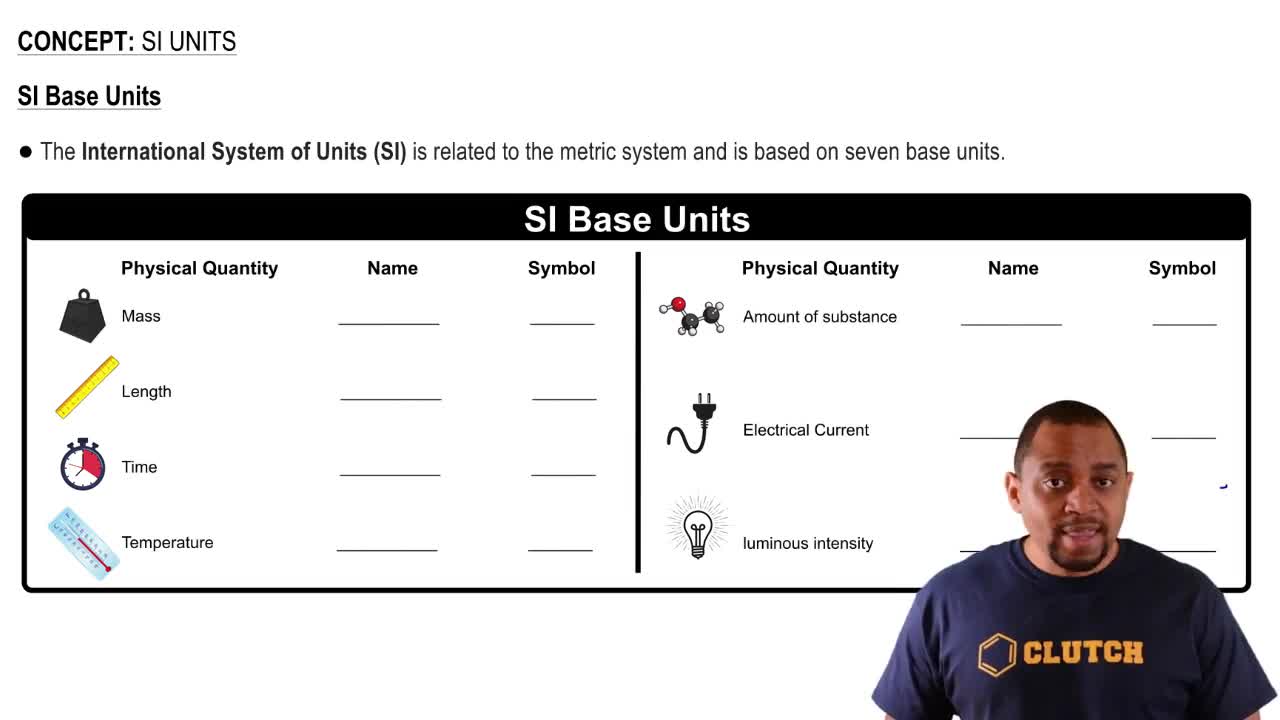
Ideal Gas Law Formula

Concentration Units

Understanding concentration units, such as parts per billion (ppb), is vital for interpreting the question. One ppb indicates that there is one part of a substance in one billion parts of the total mixture, allowing for the conversion of concentration into moles and subsequently into mass, which is necessary for calculating the allowable mass of Ni(CO)4 in the laboratory.
추천 영상:

Volume Conversion

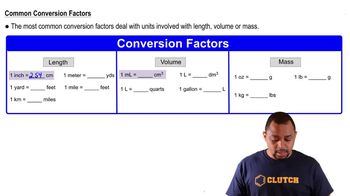
To solve the problem, it is important to convert the dimensions of the laboratory room from feet to a volume measurement compatible with the Ideal Gas Law, typically liters or cubic meters. This conversion allows for accurate calculations of the total volume of air in the room, which is needed to determine how much nickel carbonyl can be present at the specified concentration.
추천 영상:
가이드 코스
02:38
Common Conversion Factors
관련 실천
교과서 질문

Carbon dioxide, which is recognized as the major contributor to global warming as a “greenhouse gas,” is formed when fossil fuels are combusted, as in electrical power plants fueled by coal, oil, or natural gas. One potential way to reduce the amount of CO2 added to the atmosphere is to store it as a compressed gas in underground formations. Consider a 1000-megawatt coal-fired power plant that produces about 6×10⁶ tons of CO2 per year. a. Assuming ideal-gas behavior, 1.00 atm, and 27°C, calculate the volume of CO2 produced by this power plant.

교과서 질문

Assume that a single cylinder of an automobile engine has a volume of 524 cm3. a. If the cylinder is full of air at 74°C and 0.980 atm, how many moles of O2 are present? (The mole fraction of O2 in dry air is 0.2095.)

1
views
교과서 질문

Assume that an exhaled breath of air consists of 74.8% N2, 15.3% O2, 3.7% CO2, and 6.2% water vapor. a. If the total pressure of the gases is 0.985 atm, calculate the partial pressure of each component of the mixture.

1
views
교과서 질문

A gas bubble with a volume of 1.0 mm3 originates at the bottom of a lake where the pressure is 3.0 atm. Calculate its volume when the bubble reaches the surface of the lake where the pressure is 730 torr, assuming that the temperature does not change.

691
views
교과서 질문

Consider the arrangement of bulbs shown in the drawing. Each of the bulbs contains a gas at the pressure shown. What is the pressure of the system when all the stopcocks are opened, assuming that the temperature remains constant? (We can neglect the volume of the capillary tubing connecting the bulbs.)

1529
views