If a car tire is filled to a pressure of 32.0 lb/in.2 (psi) measured at 75°F, what will be the tire pressure if the tires heat up to 120°F during driving?
Ch.10 - Gases

10장, 문제 25c
You have a gas at 25 C confined to a cylinder with a movable piston. Which of the following actions would double the gas pressure? (a) Lifting up on the piston to double the volume while keeping the temperature constant (b) Heating the gas so that its temperature rises from 25 C to 50 C, while keeping the volume constant (c) Pushing down on the piston to halve the volume while keeping the temperature constant.
검증된 단계별 안내1
Identify the initial conditions of the gas: constant temperature at 25°C and a certain volume.
Recall the ideal gas law: \( PV = nRT \), where \( P \) is pressure, \( V \) is volume, \( n \) is the number of moles, \( R \) is the gas constant, and \( T \) is temperature in Kelvin.
Convert the given temperature from Celsius to Kelvin: \( T(K) = 25 + 273.15 \).
Analyze each option: (a) Doubling the volume while keeping temperature constant will halve the pressure, according to Boyle's Law (\( P_1V_1 = P_2V_2 \)). (b) Doubling the temperature in Kelvin will double the pressure if volume is constant, according to Gay-Lussac's Law (\( \frac{P_1}{T_1} = \frac{P_2}{T_2} \)). (c) Halving the volume while keeping temperature constant will double the pressure, according to Boyle's Law.
Determine which action results in doubling the pressure: Option (c) is correct, as halving the volume while keeping temperature constant will double the pressure.

비슷한 문제에 대한 검증된 영상 답변:
이 영상 해법은 위 문제에 도움이 된다고 튜터들이 추천한 것입니다.
영상 길이:
3m주요 개념
질문에 올바르게 답하기 위해 반드시 이해해야 하는 핵심 개념들은 다음과 같습니다.
Ideal Gas Law
The Ideal Gas Law, represented as PV = nRT, relates the pressure (P), volume (V), and temperature (T) of an ideal gas. It shows that for a given amount of gas (n) at a constant temperature, pressure is inversely proportional to volume. This means that if the volume decreases, the pressure increases, assuming temperature remains constant.
추천 영상:
가이드 코스
Ideal Gas Law Formula
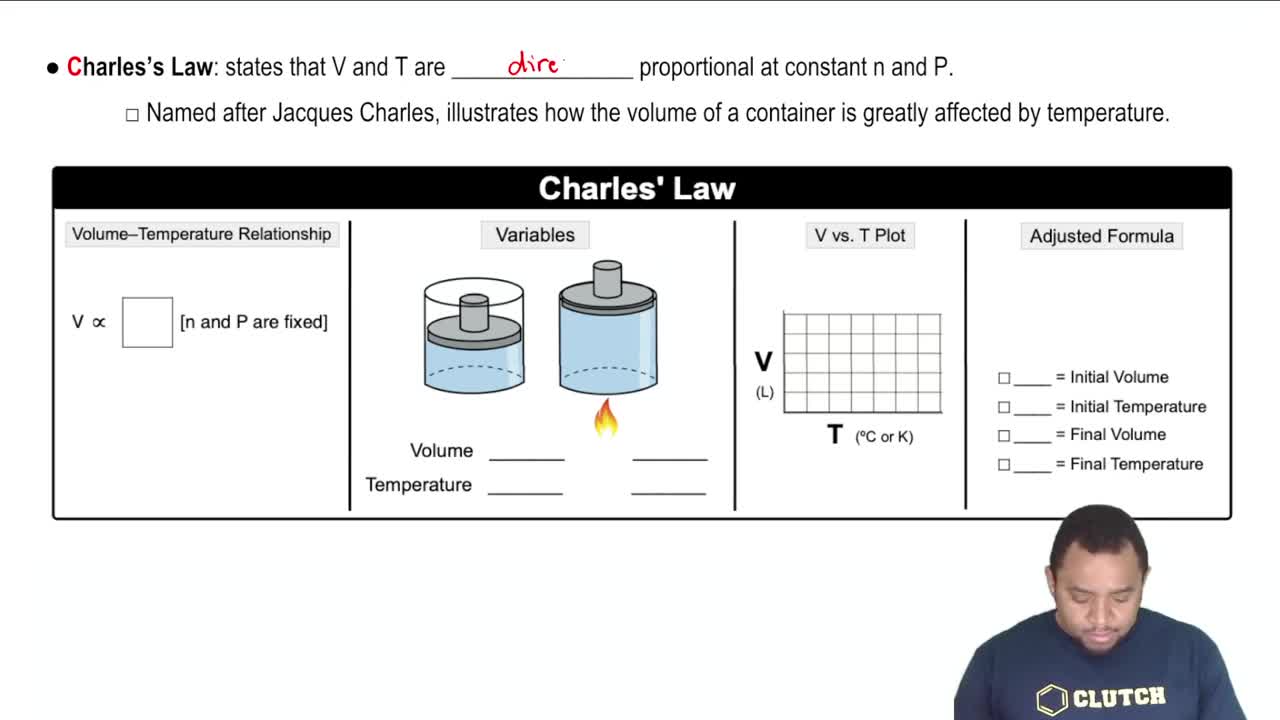
Charles's Law
Charles's Law states that the volume of a gas is directly proportional to its temperature when pressure is held constant. This means that increasing the temperature of a gas will increase its volume, which can affect the pressure if the volume is not allowed to change. Understanding this law helps in analyzing how temperature changes impact gas behavior.
추천 영상:
가이드 코스
Charles's Law
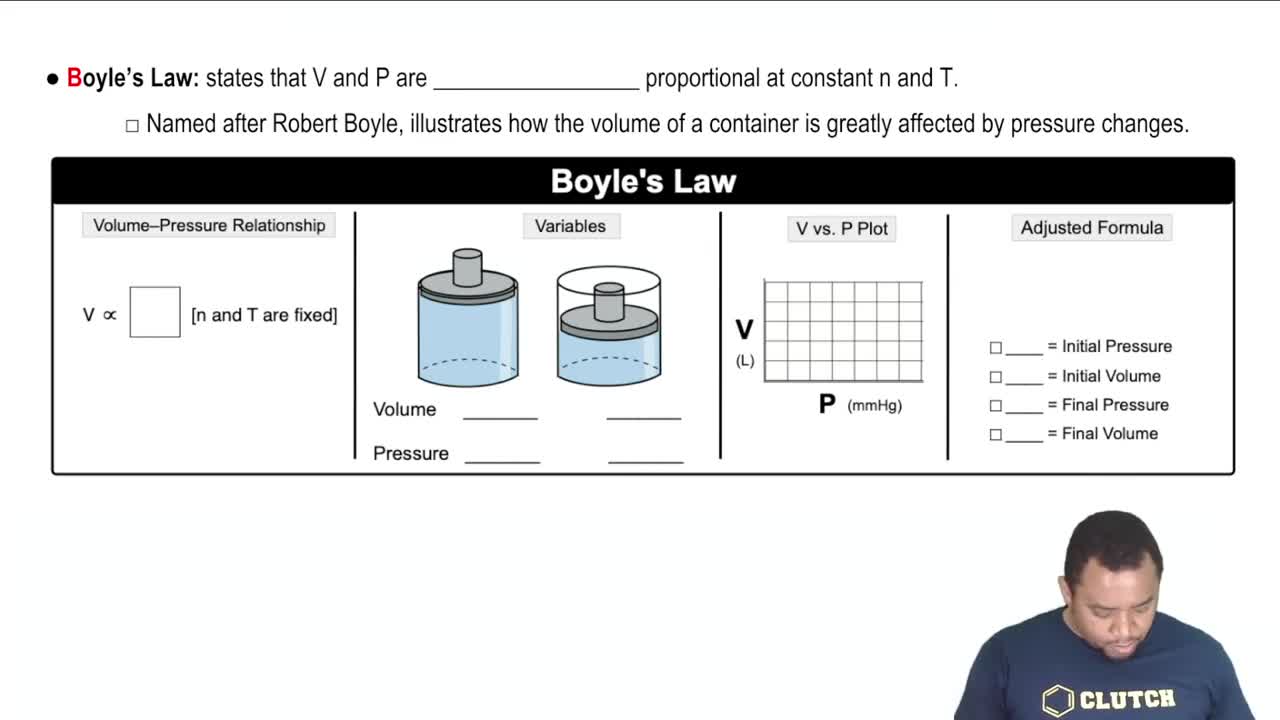
Boyle's Law
Boyle's Law states that the pressure of a gas is inversely proportional to its volume when temperature is held constant. This means that if the volume of a gas is halved, the pressure will double, provided the temperature does not change. This principle is crucial for understanding how compressing a gas affects its pressure.
추천 영상:
가이드 코스
Boyle's Law
관련 실천
교과서 질문
3
views
교과서 질문
(a) Amonton's law expresses the relationship between pressure and temperature. Use Charles's law and Boyle's law to derive the proportionality relationship between P and T.
939
views
교과서 질문
If the atmospheric pressure is 0.995 atm, what is the pressure of the enclosed gas in each of the three cases depicted in the drawing? Assume that the gray liquid is mercury. (ii)
629
views
교과서 질문
An open-end manometer containing mercury is connected to a container of gas, as depicted in Sample Exercise 10.2. What is the pressure of the enclosed gas in torr in each of the following situations? (a) The mercury in the arm attached to the gas is 15.4 mm higher than in the one open to the atmosphere; atmospheric pressure is 0.985 atm.
1014
views