

Ch.13 - Properties of Solutions
Brown - Chemistry: The Central Science 15th Edition
Brown15th EditionChemistry: The Central ScienceISBN: 9780137542970당신이 사용하는 게 아니라요?교과서 변경
13장, 문제 61

Suppose that you want to use reverse osmosis to reduce the salt content of brackish water containing 0.22 M total salt concentration to a value of 0.01 M, thus rendering it usable for human consumption. What is the minimum pressure that needs to be applied in the permeators (Figure 13.26) to achieve this goal, assuming that the operation occurs at 298 K?

검증된 단계별 안내
1
Identify the initial and final concentrations of the salt solution: initial concentration \( C_i = 0.22 \text{ M} \) and final concentration \( C_f = 0.01 \text{ M} \).
Use the van 't Hoff equation for osmotic pressure: \( \Pi = iMRT \), where \( i \) is the van 't Hoff factor, \( M \) is the molarity, \( R \) is the ideal gas constant (0.0821 L·atm/mol·K), and \( T \) is the temperature in Kelvin.
Calculate the initial osmotic pressure \( \Pi_i \) using the initial concentration \( C_i \), assuming \( i = 1 \) for simplicity: \( \Pi_i = iC_iRT \).
Calculate the final osmotic pressure \( \Pi_f \) using the final concentration \( C_f \): \( \Pi_f = iC_fRT \).
Determine the minimum pressure needed by finding the difference in osmotic pressures: \( \Delta \Pi = \Pi_i - \Pi_f \). This \( \Delta \Pi \) is the minimum pressure that must be applied to achieve the desired reduction in salt concentration.

비슷한 문제에 대한 검증된 영상 답변:

이 영상 해법은 위 문제에 도움이 된다고 튜터들이 추천한 것입니다.
영상 길이:
2m

주요 개념

질문에 올바르게 답하기 위해 반드시 이해해야 하는 핵심 개념들은 다음과 같습니다.

Reverse Osmosis

Reverse osmosis is a water purification process that uses a semipermeable membrane to remove ions, molecules, and larger particles from drinking water. In this process, pressure is applied to overcome osmotic pressure, allowing water to flow from a region of higher solute concentration to a region of lower solute concentration, effectively reducing the salt content in brackish water.
추천 영상:
가이드 코스
00:38
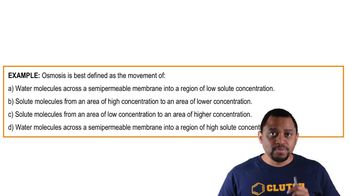
Osmosis Example

Osmotic Pressure

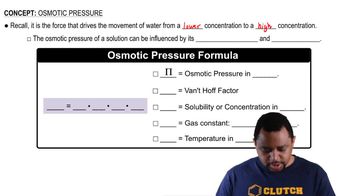
Osmotic pressure is the pressure required to stop the flow of solvent into a solution through a semipermeable membrane. It is directly proportional to the concentration of solute particles in the solution, as described by the van 't Hoff equation. Understanding osmotic pressure is crucial for determining the minimum pressure needed in reverse osmosis to achieve the desired reduction in salt concentration.
추천 영상:
가이드 코스
01:13
Osmotic Pressure Formula

Ideal Gas Law and Temperature

The ideal gas law relates the pressure, volume, temperature, and number of moles of a gas, expressed as PV=nRT. In the context of reverse osmosis, temperature (298 K in this case) affects the kinetic energy of the molecules and, consequently, the osmotic pressure. This relationship is important for calculating the minimum pressure needed to achieve the desired salt concentration in the water.
추천 영상:
가이드 코스
01:15
Ideal Gas Law Formula