Indicate whether each statement is true or false: (c) As you cool a saturated solution from high temperature to low temperature, solids start to crystallize out of solution if you achieve a supersaturated solution.

Ch.13 - Properties of Solutions

13장, 문제 34c
Which of the following in each pair is likely to be more soluble in water: (c) HCl or ethyl chloride (CH3CH2Cl)? Explain in each case.
검증된 단계별 안내1
Step 1: Understand the concept of 'like dissolves like'. This means that polar substances tend to dissolve in polar solvents, and nonpolar substances tend to dissolve in nonpolar solvents. Water is a polar solvent.
Step 2: Identify the polarity of the substances. HCl is a polar molecule because it has a polar bond due to the difference in electronegativity between hydrogen and chlorine. Ethyl chloride (CH3CH2Cl) is also polar, but less so than HCl because the electronegativity difference between carbon and hydrogen is less than that between hydrogen and chlorine.
Step 3: Consider the ability of the substances to form hydrogen bonds with water. HCl can form hydrogen bonds with water because chlorine is a highly electronegative atom. Ethyl chloride, on the other hand, cannot form hydrogen bonds with water because it does not have a hydrogen atom bonded to an electronegative atom.
Step 4: Based on the above considerations, HCl is likely to be more soluble in water than ethyl chloride. This is because HCl is more polar and can form hydrogen bonds with water, while ethyl chloride is less polar and cannot form hydrogen bonds with water.
Step 5: Remember that these are general guidelines and actual solubility can be influenced by other factors such as temperature and pressure.

비슷한 문제에 대한 검증된 영상 답변:
이 영상 해법은 위 문제에 도움이 된다고 튜터들이 추천한 것입니다.
영상 길이:
1m주요 개념
질문에 올바르게 답하기 위해 반드시 이해해야 하는 핵심 개념들은 다음과 같습니다.
Polarity and Solubility
Polarity refers to the distribution of electrical charge over the atoms in a molecule. Polar molecules, which have a significant difference in electronegativity between their atoms, tend to dissolve well in polar solvents like water. This is due to the 'like dissolves like' principle, where polar solutes are more soluble in polar solvents, while nonpolar solutes are better dissolved in nonpolar solvents.
추천 영상:
가이드 코스
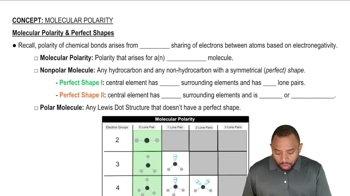
Molecular Polarity
Hydrogen Bonding
Hydrogen bonding is a strong type of dipole-dipole interaction that occurs when hydrogen is bonded to highly electronegative atoms like oxygen, nitrogen, or fluorine. In the case of HCl, the molecule can form hydrogen bonds with water, enhancing its solubility. Ethyl chloride, being a nonpolar molecule, lacks the ability to form such interactions, making it less soluble in water.
추천 영상:
가이드 코스
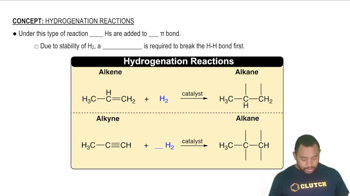
Hydrogenation Reactions
Molecular Structure and Functional Groups
The molecular structure and functional groups of a compound significantly influence its solubility. HCl is a simple diatomic molecule that ionizes in water to form H⁺ and Cl⁻ ions, increasing its solubility. In contrast, ethyl chloride has a larger hydrocarbon structure with a chlorine atom, which does not ionize and is less compatible with water, leading to lower solubility.
추천 영상:
가이드 코스
Functional Groups Example
관련 실천
교과서 질문
교과서 질문
Which of the following in each pair is likely to be more soluble in water: (a) cyclohexane (C6H12) or glucose (C6H12O6),
1027
views
교과서 질문
Indicate whether each statement is true or false: (d) If you take a saturated solution and raise its temperature, you can (usually) add more solute and make the solution even more concentrated.
445
views
교과서 질문
Which of the following in each pair is likely to be more soluble in water: (b) propionic acid (CH3CH2COOH) or sodium propionate (CH3CH2COONa)
교과서 질문
Which of the following in each pair is likely to be more soluble in hexane, C6H14: (a) CCl4 or CaCl2, (b) benzene (C6H6) or glycerol, CH2(OH)CH(OH)CH2OH, (c) octanoic acid, CH3CH2CH2CH2CH2CH2CH2COOH, or acetic acid, CH3COOH? Explain your answer in each case.
2190
views