

Ch.14 - Chemical Kinetics
Brown - Chemistry: The Central Science 15th Edition
Brown15th EditionChemistry: The Central ScienceISBN: 9780137542970당신이 사용하는 게 아니라요?교과서 변경
14장, 문제 74a

You have studied the gas-phase oxidation of HBr by O2: 4 HBr(g) + O2(g) → 2 H2O(g) + 2 Br2(g)
You find the reaction to be first order with respect to HBr and first order with respect to O2. You propose the following mechanism:
HBr(g) + O2(g) → HOOBr(g)
HOOBr(g) + HBr(g) → 2 HOBr(g)
HOBr(g) + HBr(g) → H2O(g) + Br2(g)
(a) Confirm that the elementary reactions add to give the overall reaction.

검증된 단계별 안내
1
insert step 1> Identify the given elementary reactions and the overall reaction.
insert step 2> Write down each elementary reaction: 1) HBr(g) + O_2(g) → HOOBr(g), 2) HOOBr(g) + HBr(g) → 2 HOBr(g), 3) HOBr(g) + HBr(g) → H_2O(g) + Br_2(g).
insert step 3> Add the reactants and products of the elementary reactions to see if they match the overall reaction: 4 HBr(g) + O_2(g) → 2 H_2O(g) + 2 Br_2(g).
insert step 4> Cancel out any intermediates that appear on both sides of the combined equation.
insert step 5> Verify that the remaining reactants and products match the overall reaction, confirming the mechanism is consistent with the overall reaction.

비슷한 문제에 대한 검증된 영상 답변:

이 영상 해법은 위 문제에 도움이 된다고 튜터들이 추천한 것입니다.
영상 길이:
2m

주요 개념

질문에 올바르게 답하기 위해 반드시 이해해야 하는 핵심 개념들은 다음과 같습니다.

Stoichiometry

Stoichiometry is the calculation of reactants and products in chemical reactions. It involves balancing chemical equations to ensure that the number of atoms for each element is conserved. In this context, confirming that the elementary reactions add up to the overall reaction requires checking that the total number of each type of atom on the reactant side equals that on the product side.
추천 영상:
가이드 코스
01:16
Stoichiometry Concept

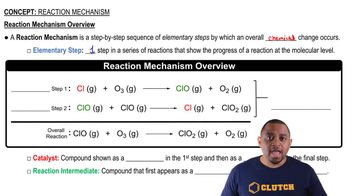
Reaction Mechanism

A reaction mechanism is a step-by-step description of the pathway from reactants to products in a chemical reaction. It includes elementary steps, which are individual reactions that occur in sequence. Understanding the proposed mechanism helps in analyzing how the overall reaction occurs and how the rate laws are derived from these elementary steps.
추천 영상:
가이드 코스
03:06
Reaction Mechanism Overview

Rate Law

The rate law expresses the relationship between the rate of a chemical reaction and the concentration of its reactants. For this reaction, it is stated to be first order with respect to both HBr and O2, indicating that the rate is directly proportional to the concentration of each reactant. This concept is crucial for understanding how the proposed mechanism aligns with the observed reaction order.
추천 영상:
가이드 코스
01:52
Rate Law Fundamentals
관련 실천
교과서 질문

The reaction 2 NO1g2 + Cl21g2¡2 NOCl1g2 was performed and the following data were obtained under conditions of constant 3Cl24:

(a) Is the following mechanism consistent with the data? NO1g2 + Cl21g2ΔNOCl21g2 1fast2 NOCl21g2 + NO1g2¡2 NOCl1g2 1slow2

292
views
교과서 질문

(c) Do catalysts affect the overall enthalpy change for a reaction, the activation energy, or both?

574
views
교과서 질문

The decomposition of hydrogen peroxide is catalyzed by iodide ion. The catalyzed reaction is thought to proceed by a two-step mechanism:

H2O2(aq) + I-(aq) → H2O(l) + IO-(aq) (slow)

IO-(aq) + H2O2(aq) → H2O(l) + O2(g) + I-(aq) (fast)

(c) Assuming that the first step of the mechanism is rate determining, predict the rate law for the overall process.

1669
views
교과서 질문

(a) What is a catalyst? (b) What is the difference between a homogeneous and a heterogeneous catalyst?

교과서 질문

The decomposition of hydrogen peroxide is catalyzed by iodide ion. The catalyzed reaction is thought to proceed by a two-step mechanism:

H2O2(aq) + I-(aq) → H2O(l) + IO-(aq) (slow)

IO-(aq) + H2O2(aq) → H2O(l) + O2(g) + I-(aq) (fast)

(b) Identify the intermediate, if any, in the mechanism.

1697
views
교과서 질문

You have studied the gas-phase oxidation of HBr by O2: 4 HBr(g) + O2(g) → 2 H2O(g) + 2 Br2(g)

You find the reaction to be first order with respect to HBr and first order with respect to O2. You propose the following mechanism:

HBr(g) + O2(g) → HOOBr(g)

HOOBr(g) + HBr(g) → 2 HOBr(g)

HOBr(g) + HBr(g) → H2O(g) + Br2(g)

(b) Based on the experimentally determined rate law, which step is rate determining?

1025
views