Ch.15 - Chemical Equilibrium
Brown - Chemistry: The Central Science 15th Edition
Brown15th EditionChemistry: The Central ScienceISBN: 9780137542970당신이 사용하는 게 아니라요?교과서 변경
15장, 문제 27

The following equilibria were attained at 823 K:
CoO(s) + H2(g) → Co(s) + H2O(g) Kc = 67
CoO(s) + CO(g) → Co(s) + CO2(g) Kc = 490
Based on these equilibria, calculate the value of 𝐾𝑐 for H2(𝑔)+ CO2(𝑔) ⇌ CO(𝑔) + H2O(𝑔) at 823 K.

검증된 단계별 안내
1
Identify the given reactions and their equilibrium constants: Reaction 1: CoO(s) + H_2(g) → Co(s) + H_2O(g) with K_{c1} = 67, Reaction 2: CoO(s) + CO(g) → Co(s) + CO_2(g) with K_{c2} = 490.
Write the target reaction: H_2(g) + CO_2(g) ⇌ CO(g) + H_2O(g).
Recognize that the target reaction can be derived by reversing Reaction 2 and adding it to Reaction 1.
Reverse Reaction 2: CO(s) + CO_2(g) → CoO(s) + CO(g), which changes the equilibrium constant to 1/K_{c2}.
Add the reversed Reaction 2 to Reaction 1 to obtain the target reaction, and calculate the equilibrium constant for the target reaction as K_{c} = K_{c1} * (1/K_{c2}).

비슷한 문제에 대한 검증된 영상 답변:

이 영상 해법은 위 문제에 도움이 된다고 튜터들이 추천한 것입니다.
영상 길이:
5m

주요 개념

질문에 올바르게 답하기 위해 반드시 이해해야 하는 핵심 개념들은 다음과 같습니다.

Chemical Equilibrium

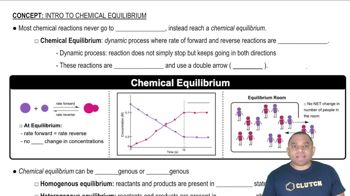
Chemical equilibrium occurs when the rates of the forward and reverse reactions are equal, resulting in constant concentrations of reactants and products. The equilibrium constant (Kc) quantifies the ratio of product concentrations to reactant concentrations at equilibrium, providing insight into the position of the equilibrium. Understanding this concept is crucial for manipulating and calculating Kc values in various reactions.
추천 영상:
가이드 코스
04:21
Chemical Equilibrium Concepts

Equilibrium Constant (Kc)

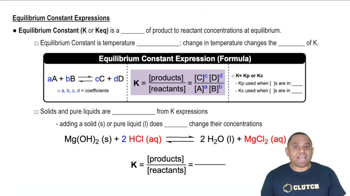
The equilibrium constant (Kc) is a numerical value that expresses the relationship between the concentrations of products and reactants at equilibrium for a given reaction at a specific temperature. It is calculated using the formula Kc = [products]^[coefficients] / [reactants]^[coefficients]. The value of Kc indicates whether the products or reactants are favored in the equilibrium state, which is essential for solving equilibrium-related problems.
추천 영상:
가이드 코스
03:20
Equilibrium Constant Expressions

Manipulating Equilibrium Expressions

Manipulating equilibrium expressions involves using the properties of Kc to derive new equilibrium constants from known ones. For example, if a reaction is reversed, the new Kc is the reciprocal of the original. Additionally, if reactions are added together, the Kc for the overall reaction is the product of the individual Kc values. This concept is vital for calculating Kc for complex reactions based on simpler, known equilibria.
추천 영상:
가이드 코스
03:20
Equilibrium Constant Expressions