Indicate whether each of the following statements about the reaction quotient Q is true or false: (b) If 𝑄𝑐 < 𝐾𝑐, the reaction needs to proceed to the right to reach equilibrium.

Ch.15 - Chemical Equilibrium

15장, 문제 41a
Indicate whether each of the following statements about the reaction quotient Q is true or false: (a) The expression for 𝑄𝑐 looks the same as the expression for 𝐾𝑐.
검증된 단계별 안내1
Understand that both the reaction quotient \( Q_c \) and the equilibrium constant \( K_c \) are calculated using the same expression, which is the ratio of the concentrations of the products to the reactants, each raised to the power of their stoichiometric coefficients.
Recognize that the difference between \( Q_c \) and \( K_c \) lies in the state of the reaction: \( Q_c \) is calculated at any point in time, while \( K_c \) is specifically at equilibrium.
Write the general expression for \( Q_c \) for a reaction: \( aA + bB \rightleftharpoons cC + dD \), where \( Q_c = \frac{[C]^c[D]^d}{[A]^a[B]^b} \).
Note that the expression for \( K_c \) is identical to that of \( Q_c \), \( K_c = \frac{[C]^c[D]^d}{[A]^a[B]^b} \), but it is evaluated when the system is at equilibrium.
Conclude that the statement is true because the mathematical expressions for \( Q_c \) and \( K_c \) are indeed the same, differing only in the conditions under which they are evaluated.

비슷한 문제에 대한 검증된 영상 답변:
이 영상 해법은 위 문제에 도움이 된다고 튜터들이 추천한 것입니다.
영상 길이:
1m주요 개념
질문에 올바르게 답하기 위해 반드시 이해해야 하는 핵심 개념들은 다음과 같습니다.
Reaction Quotient (Q)
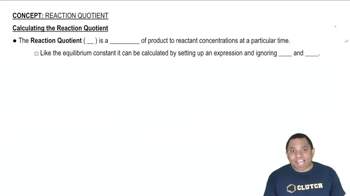
The reaction quotient, denoted as Q, is a measure of the relative concentrations of products and reactants in a chemical reaction at any point in time. It is calculated using the same expression as the equilibrium constant (K), but it can be evaluated at any set of concentrations, not just at equilibrium. Q helps determine the direction in which a reaction will proceed to reach equilibrium.
추천 영상:
가이드 코스
Reaction Quotient Q
Equilibrium Constant (K)
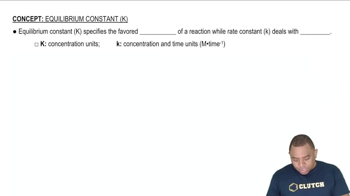
The equilibrium constant, represented as K, quantifies the ratio of the concentrations of products to reactants at equilibrium for a reversible reaction. It is a specific value that remains constant at a given temperature and is derived from the balanced chemical equation. K provides insight into the extent of a reaction and whether products or reactants are favored at equilibrium.
추천 영상:
가이드 코스
Equilibrium Constant K
Comparison of Q and K
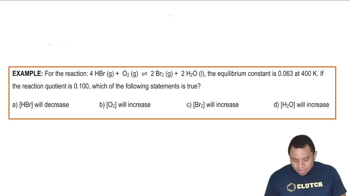
The relationship between Q and K is crucial for predicting the behavior of a reaction. If Q < K, the reaction will proceed in the forward direction to produce more products; if Q > K, the reaction will shift backward to form more reactants. When Q equals K, the system is at equilibrium, and no net change occurs. Understanding this comparison is essential for analyzing dynamic chemical systems.
추천 영상:
가이드 코스
Comparing Q to K Example
관련 실천
교과서 질문
교과서 질문
At 100°C, the equilibrium constant for the reaction COCl2(𝑔) ⇌ CO(𝑔) + Cl2(𝑔) has the value 𝐾𝑐 = 2.19×10⁻¹⁰. Are the following mixtures of COCl2, CO, and Cl2 at 100°C at equilibrium? If not, indicate the direction that the reaction must proceed to achieve equilibrium.
(a) [COCl2] = 2.00×10⁻³ M, [CO] = 3.3×10⁻⁶ M, [Cl2] = 6.62×10⁻⁶ M
(b) [COCl2] = 4.50×10⁻² M, [CO] = 1.1×10⁻⁷ M, [Cl2] = 2.25×10⁻⁶ M
(c) [COCl2] = 0.0100 M, [CO] = [Cl2] = 1.48×10⁻⁶ M
736
views
교과서 질문
A mixture of 0.2000 mol of CO2, 0.1000 mol of H2, and 0.1600 mol of H2O is placed in a 2.000-L vessel. The following equilibrium is established at 500 K: CO2(g) + H2(g) ⇌ CO(g) + H2O(g) (d) Calculate Kc for the reaction.
1566
views