Ch.18 - Chemistry of the Environment
Brown - Chemistry: The Central Science 15th Edition
Brown15th EditionChemistry: The Central ScienceISBN: 9780137542970당신이 사용하는 게 아니라요?교과서 변경
18장, 문제 69a,b,c

Write balanced chemical equations for each of the following reactions: (a) The nitric oxide molecule undergoes photodissociation in the upper atmosphere. (b) The nitric oxide molecule undergoes photoionization in the upper atmosphere. (c) Nitric oxide undergoes oxidation by ozone in the stratosphere.

검증된 단계별 안내
1
Identify the reactants and products involved in the photoionization of nitric oxide (NO).
Understand that photoionization involves the absorption of a photon by a molecule, resulting in the ejection of an electron and the formation of a positive ion.
Write the chemical equation for the photoionization of nitric oxide: NO + hv → NO⁺ + e⁻, where 'hv' represents the photon energy.
Ensure that the equation is balanced in terms of both mass and charge. In this case, the number of atoms and the overall charge are balanced on both sides of the equation.
Review the concept of photoionization, which is a process where a molecule absorbs light energy and loses an electron, forming a cation.

비슷한 문제에 대한 검증된 영상 답변:

이 영상 해법은 위 문제에 도움이 된다고 튜터들이 추천한 것입니다.
영상 길이:
56s

주요 개념

질문에 올바르게 답하기 위해 반드시 이해해야 하는 핵심 개념들은 다음과 같습니다.

Photoionization

Photoionization is the process in which an atom or molecule absorbs a photon and subsequently loses an electron, resulting in the formation of a positively charged ion. This phenomenon is significant in atmospheric chemistry, particularly in the upper atmosphere where high-energy ultraviolet (UV) radiation is prevalent. In the case of nitric oxide (NO), the absorption of UV light leads to its ionization, which can affect various atmospheric processes.

Balanced Chemical Equations

A balanced chemical equation represents a chemical reaction where the number of atoms for each element is the same on both the reactant and product sides. Balancing equations is crucial for obeying the law of conservation of mass, which states that matter cannot be created or destroyed in a chemical reaction. This ensures that the equation accurately reflects the stoichiometry of the reaction, allowing for proper calculations of reactants and products.
추천 영상:
가이드 코스
01:32
Balancing Chemical Equations

Nitric Oxide (NO) in the Atmosphere

Nitric oxide (NO) is a significant molecule in atmospheric chemistry, playing a role in the formation of smog and acid rain. It is produced from various sources, including combustion processes and lightning. In the upper atmosphere, NO can undergo reactions that lead to the formation of nitrogen dioxide (NO2) and other nitrogen oxides, which are important for understanding air quality and the chemistry of the ozone layer.
추천 영상:
가이드 코스
00:58
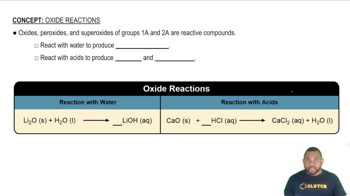
Oxide Reactions
관련 실천
교과서 질문

(b) Will Mg(OH)2 precipitate when 4.0 g of Na2CO3 is added to 1.00 L of a solution containing 125 ppm of Mg2+?

367
views

교과서 질문

(a) The EPA threshold for acceptable levels of lead ions in water is 615 ppb. What is the molarity of an aqueous solution with a concentration of 15 ppb?

1
views
교과서 질문

One of the possible consequences of climate change is an increase in the temperature of ocean water. The oceans serve as a 'sink' for CO2 by dissolving large amounts of it.

(a) The figure below shows the solubility of CO2 in water as a function of temperature. Does CO2 behave more or less similarly to other gases in this respect?

379
views
교과서 질문

The solar power striking Earth every day averages 168 watts per square meter. The highest ever recorded electrical power usage in New York City was 13,200 MW. A record established in July of 2013. Considering that present technology for solar energy conversion is about 10% efficient, from how many square meters of land must sunlight be collected in order to provide this peak power? (For compar- ison, the total area of New York City is 830 km2.)

1768
views
교과서 질문

The rate of solar energy striking Earth averages 168 watts per square meter. The rate of energy radiated from Earth's surface averages 390 watts per square meter. Comparing these numbers, one might expect that the planet would cool quickly, yet it does not. Why not?

1865
views
교과서 질문

Write balanced chemical equations for each of the following reactions: (d) Nitrogen dioxide dissolves in water to form nitric acid and nitric oxide.

536
views