Ch.19 - Chemical Thermodynamics
19์žฅ, ๋ฌธ์ œ 28

(a) What sign for ฮ”๐‘† do you expect when the pressure on 0.600 mol of an ideal gas at 350 K is increased isothermally from an initial pressure of 0.750 atm?
(b) If the final pressure on the gas is 1.20 atm, calculate the entropy change for the process.
(c) Which of the following statements about this process are true? (i) The entropy change you calculated will be the same for at any other constant temperature. (ii) The value of ฮ”๐‘† you calculated is valid only if the compression is done irreversibly. (iii) If the number of moles of gas being compressed were decreased by a factor of three, the entropy change would increase by a factor of three.

๊ฒ€์ฆ๋œ ๋‹จ๊ณ„๋ณ„ ์•ˆ๋‚ด
1
(a) Sign of ฮ”S: When the pressure on a gas is increased isothermally, the volume decreases. Since entropy (ฮ”S) is related to the disorder or randomness of a system, a decrease in volume at constant temperature typically leads to a decrease in entropy. Therefore, we expect ฮ”S to be negative.
(b) Calculating ฮ”S: Use the formula for entropy change for an ideal gas under isothermal conditions: \( \Delta S = nR \ln \left( \frac{P_1}{P_2} \right) \), where \( n \) is the number of moles, \( R \) is the ideal gas constant (8.314 J/molยทK), \( P_1 \) is the initial pressure, and \( P_2 \) is the final pressure. Substitute the given values: \( n = 0.600 \) mol, \( P_1 = 0.750 \) atm, \( P_2 = 1.20 \) atm.
(c) Evaluating statements: (i) True, because entropy change for an isothermal process depends only on the initial and final states, not on the path or specific temperature, as long as the temperature is constant. (ii) False, the calculated ฮ”S is valid for a reversible process; for an irreversible process, the entropy change would be different. (iii) False, if the number of moles is decreased by a factor of three, the entropy change would decrease by a factor of three, not increase.
Additional Consideration: Remember that the natural logarithm function \( \ln \) will yield a negative value when the argument is less than 1, which aligns with our expectation of a negative ฮ”S for compression.
Final Thought: Always check the units and ensure consistency, especially when using the ideal gas constant \( R \). Here, we used \( R = 8.314 \) J/molยทK, which is appropriate for calculations involving entropy in joules.>

๋น„์Šทํ•œ ๋ฌธ์ œ์— ๋Œ€ํ•œ ๊ฒ€์ฆ๋œ ์˜์ƒ ๋‹ต๋ณ€:

์ด ์˜์ƒ ํ•ด๋ฒ•์€ ์œ„ ๋ฌธ์ œ์— ๋„์›€์ด ๋œ๋‹ค๊ณ  ํŠœํ„ฐ๋“ค์ด ์ถ”์ฒœํ•œ ๊ฒƒ์ž…๋‹ˆ๋‹ค.
์˜์ƒ ๊ธธ์ด:
3m

์ฃผ์š” ๊ฐœ๋…

์งˆ๋ฌธ์— ์˜ฌ๋ฐ”๋ฅด๊ฒŒ ๋‹ตํ•˜๊ธฐ ์œ„ํ•ด ๋ฐ˜๋“œ์‹œ ์ดํ•ดํ•ด์•ผ ํ•˜๋Š” ํ•ต์‹ฌ ๊ฐœ๋…๋“ค์€ ๋‹ค์Œ๊ณผ ๊ฐ™์Šต๋‹ˆ๋‹ค.

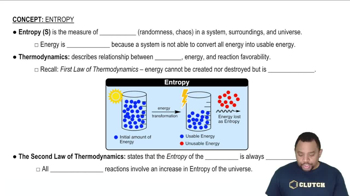
Entropy (ฮ”S)

Entropy is a measure of the disorder or randomness in a system. In thermodynamics, a positive change in entropy (ฮ”S > 0) indicates an increase in disorder, while a negative change (ฮ”S < 0) suggests a decrease in disorder. For an ideal gas, changes in entropy can be influenced by factors such as temperature, pressure, and volume, particularly during processes like expansion or compression.
์ถ”์ฒœ ์˜์ƒ:

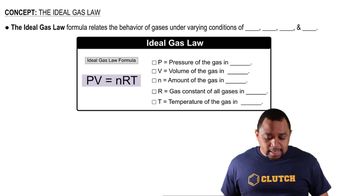
Ideal Gas Law

The Ideal Gas Law relates the pressure, volume, temperature, and number of moles of an ideal gas through the equation PV = nRT. This law is essential for understanding how changes in pressure and volume affect the behavior of gases. In the context of the question, it helps predict how the entropy of the gas changes when the pressure is altered while maintaining a constant temperature.
์ถ”์ฒœ ์˜์ƒ:

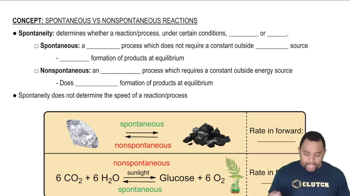
Isothermal Process

An isothermal process occurs at a constant temperature, meaning that any heat added to or removed from the system does not change its temperature. For an ideal gas undergoing isothermal compression or expansion, the internal energy remains constant, and the work done on or by the gas directly affects its entropy. Understanding this concept is crucial for calculating the entropy change during the given process.
์ถ”์ฒœ ์˜์ƒ: