
Indicate whether each statement is true or false. (a) Unlike enthalpy, where we can only ever know changes in H, we can know absolute values of S. (b) If you heat a gas such as CO2, you will increase its degrees of translational, rotational and vibrational motions. (c) CO2(g) and Ar(g) have nearly the same molar mass. At a given temperature, they will have the same number of microstates.
Ch.19 - Chemical Thermodynamics

19장, 문제 41a
Predict the sign of the entropy change of the system for each of the following reactions: (a) N2(g) + 3 H2(g) → 2 NH3(g)
검증된 단계별 안내1
Identify the states of matter for the reactants and products. In this reaction, all species are gases.
Count the number of moles of gaseous reactants and products. For the reactants, there are 1 mole of N_2 and 3 moles of H_2, totaling 4 moles. For the products, there are 2 moles of NH_3.
Compare the total number of moles of gas on the reactant side to the product side. The reactant side has 4 moles of gas, while the product side has 2 moles of gas.
Recall that entropy (S) is a measure of disorder or randomness. A decrease in the number of moles of gas typically indicates a decrease in entropy, as gases have higher entropy than liquids or solids due to their greater freedom of movement.
Predict the sign of the entropy change (ΔS) for the system. Since the number of moles of gas decreases from reactants to products, the entropy change is likely negative (ΔS < 0).

비슷한 문제에 대한 검증된 영상 답변:
이 영상 해법은 위 문제에 도움이 된다고 튜터들이 추천한 것입니다.
영상 길이:
1m주요 개념
질문에 올바르게 답하기 위해 반드시 이해해야 하는 핵심 개념들은 다음과 같습니다.
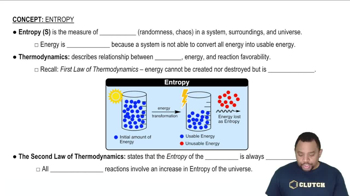
Entropy (S)
Entropy is a measure of the disorder or randomness in a system. In thermodynamics, it quantifies the number of ways a system can be arranged, with higher entropy indicating greater disorder. Understanding entropy is crucial for predicting the spontaneity of reactions and the direction of energy flow.
추천 영상:
가이드 코스
Entropy in Thermodynamics
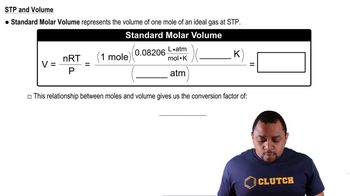
Gaseous Reactions and Molar Volume
In reactions involving gases, the number of moles of gas can significantly affect entropy. When the number of gas molecules decreases, as in the reaction N2(g) + 3 H2(g) → 2 NH3(g), the system becomes more ordered, typically resulting in a negative change in entropy. This concept is essential for analyzing the entropy change in gaseous reactions.
추천 영상:
가이드 코스
Standard Molar Volume
Second Law of Thermodynamics
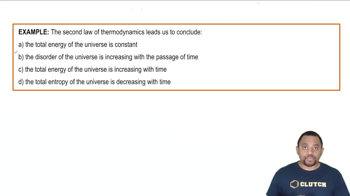
The Second Law of Thermodynamics states that the total entropy of an isolated system can never decrease over time. It implies that spontaneous processes increase the overall entropy of the universe. This principle helps in predicting whether a reaction will occur spontaneously based on the sign of the entropy change associated with the reaction.
추천 영상:
가이드 코스
Second Law of Thermodynamics Example
관련 실천
교과서 질문
408
views
교과서 질문
Predict the sign of the entropy change of the system for each of the following reactions: (d) Al2O3(s) + 3 H2(g) → 2 Al(s) + 3 H2O(g)
1504
views
교과서 질문
Predict the sign of the entropy change of the system for each of the following reactions: (b) CaCO3(s) → CaO(s) + CO2(g)
504
views
교과서 질문
Predict the sign of the entropy change of the system for each of the following reactions: (c) 3 C2H2(g) → C6H6(g)
927
views
