

Ch.2 - Atoms, Molecules, and Ions
Brown - Chemistry: The Central Science 15th Edition
Brown15th EditionChemistry: The Central ScienceISBN: 9780137542970당신이 사용하는 게 아니라요?교과서 변경
2장, 문제 19a

The radius of an atom of gold (Au) is about 1.35 Å. a. Express this distance in nanometers (nm) and in picometers (pm).

검증된 단계별 안내
1
Identify the conversion factors: 1 Ångström (Å) is equal to 0.1 nanometers (nm) and 100 picometers (pm).
Convert the radius from Ångströms to nanometers by multiplying the given value by the conversion factor from Å to nm.
Convert the radius from Ångströms to picometers by multiplying the given value by the conversion factor from Å to pm.
Write down the converted values in nm and pm, ensuring the correct number of significant figures based on the given data.
Verify the units and values to ensure accuracy in the conversion.

비슷한 문제에 대한 검증된 영상 답변:

이 영상 해법은 위 문제에 도움이 된다고 튜터들이 추천한 것입니다.
영상 길이:
3m

주요 개념

질문에 올바르게 답하기 위해 반드시 이해해야 하는 핵심 개념들은 다음과 같습니다.

Unit Conversion

Unit conversion is the process of converting a quantity expressed in one unit to another unit. In this case, we need to convert the atomic radius of gold from angstroms (Å) to nanometers (nm) and picometers (pm). Understanding the relationships between these units is essential, as 1 Å equals 0.1 nm and 1 Å equals 100 pm.
추천 영상:
가이드 코스
01:56
Conversion Factors

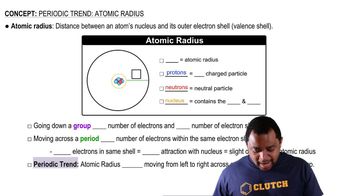
Atomic Radius

The atomic radius is a measure of the size of an atom, typically defined as the distance from the nucleus to the outermost shell of electrons. For gold (Au), the atomic radius is approximately 1.35 Å, which provides insight into its chemical properties and behavior in bonding. This concept is fundamental in understanding the physical dimensions of elements.
추천 영상:

Metric System

The metric system is a decimal-based system of measurement used globally, which includes units such as meters, grams, and liters. In the context of this question, it is important to recognize how different metric prefixes (like nano- and pico-) relate to the base unit, allowing for precise measurements in scientific contexts. Familiarity with these prefixes aids in effective communication of measurements.
추천 영상:
가이드 코스
01:16
Metric Prefixes Usage
관련 실천
교과서 질문

Millikan determined the charge on the electron by studying the static charges on oil drops falling in an electric field (Figure 2.5). A student carried out this experiment using several oil drops for her measurements and calculated the charges on the drops. She obtained the following data: Droplet Calculated Charge (C) A 1.60 * 10-19 B 3.15 * 10-19 C 4.81 * 10-19 D 6.31 * 10-19 (b) What conclusion can the student draw from these data regarding the charge of the electron?

1377
views
교과서 질문

An atom of rhodium (Rh) has a diameter of about 2.7×10⁻⁸ cm. a. What is the radius of a rhodium atom in angstroms (Å) and in meters (m)?

2
views
교과서 질문

The radius of an atom of gold (Au) is about 1.35 Å. b. How many gold atoms would have to be lined up to span 1.0 mm?

4
views
교과서 질문

The radius of an atom of gold (Au) is about 1.35 Å. c. If the atom is assumed to be a sphere, what is the volume in cm3 of a single Au atom?

1
views
교과서 질문

Millikan determined the charge on the electron by studying the static charges on oil drops falling in an electric field (Figure 2.5). A student carried out this experiment using several oil drops for her measurements and calculated the charges on the drops. She obtained the following data: Droplet Calculated Charge (C) A 1.60 * 10-19 B 3.15 * 10-19 C 4.81 * 10-19 D 6.31 * 10-19 (c) What value (and to how many significant figures) should she report for the electronic charge?

579
views
교과서 질문

Which set of statements is true about Rutherford’s gold foil experiment?

i. This is the main experiment that showed that atoms have a dense nucleus.

ii. The data from the experiment showed that alpha particles scattered equally at all angles from the gold foil.

iii. Electrons were emitted from the gold atoms in straight lines.


a. i only

b. ii only

c. iii only

d. i and ii

e. i and iii