Ch.21 - Nuclear Chemistry
Brown - Chemistry: The Central Science 15th Edition
Brown15th EditionChemistry: The Central ScienceISBN: 9780137542970당신이 사용하는 게 아니라요?교과서 변경
21장, 문제 71a

The table provided gives the number of protons (p) and neutrons (n) for four isotopes, identified only as (i)–(iv). a. Write the symbol for each of the isotopes.

검증된 단계별 안내
1
insert step 1> Identify the number of protons (p) for each isotope, as this determines the element. Use the periodic table to find the element symbol corresponding to each number of protons.
insert step 2> For each isotope, use the formula for the mass number (A), which is the sum of protons and neutrons: A = p + n.
insert step 3> Write the isotope symbol in the format: ^{A}_{Z}X, where A is the mass number, Z is the atomic number (number of protons), and X is the element symbol.
insert step 4> Repeat the process for each isotope (i)–(iv) using their respective numbers of protons and neutrons.
insert step 5> Ensure that each isotope symbol is correctly formatted and corresponds to the correct element and mass number.

비슷한 문제에 대한 검증된 영상 답변:

이 영상 해법은 위 문제에 도움이 된다고 튜터들이 추천한 것입니다.
영상 길이:
2m

주요 개념

질문에 올바르게 답하기 위해 반드시 이해해야 하는 핵심 개념들은 다음과 같습니다.

Isotopes

Isotopes are variants of a particular chemical element that have the same number of protons but different numbers of neutrons. This difference in neutron count results in varying atomic masses for the isotopes. For example, carbon-12 and carbon-14 are both isotopes of carbon, with 6 protons but 6 and 8 neutrons, respectively.
추천 영상:

Nuclear Notation

Nuclear notation is a way of representing isotopes using the element's symbol, along with the mass number (the sum of protons and neutrons) as a superscript and the atomic number (the number of protons) as a subscript. For instance, the nuclear notation for carbon-14 is written as ¹⁴₆C, where 14 is the mass number and 6 is the atomic number.
추천 영상:
가이드 코스
02:50
Standard Notation to Scientific Notation

Atomic Structure

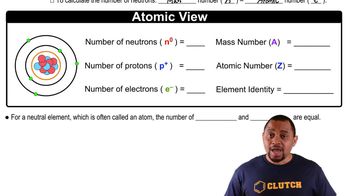
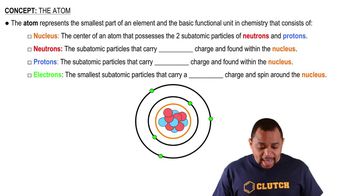
The atomic structure refers to the arrangement of protons, neutrons, and electrons within an atom. Protons and neutrons reside in the nucleus, while electrons orbit around the nucleus. Understanding atomic structure is essential for identifying isotopes, as it helps in determining the number of protons and neutrons that define each isotope's unique characteristics.
추천 영상: