Determine the empirical formula of each of the following compounds if a sample contains b. 5.28 g Sn and 3.37 g F;
Ch.3 - Chemical Reactions and Reaction Stoichiometry

3장, 문제 45b
Give the empirical formula of each of the following compounds if a sample contains b.11.66 g iron and 5.01 g oxygen
검증된 단계별 안내1
Determine the number of moles of each element in the compound. Use the molar mass of iron (Fe), which is approximately 55.85 g/mol, and the molar mass of oxygen (O), which is approximately 16.00 g/mol.
Calculate the moles of iron: \( \text{moles of Fe} = \frac{11.66 \text{ g}}{55.85 \text{ g/mol}} \).
Calculate the moles of oxygen: \( \text{moles of O} = \frac{5.01 \text{ g}}{16.00 \text{ g/mol}} \).
Determine the simplest whole number ratio of moles of iron to moles of oxygen by dividing each by the smallest number of moles calculated.
Write the empirical formula based on the simplest whole number ratio obtained in the previous step.

비슷한 문제에 대한 검증된 영상 답변:
이 영상 해법은 위 문제에 도움이 된다고 튜터들이 추천한 것입니다.
영상 길이:
1m주요 개념
질문에 올바르게 답하기 위해 반드시 이해해야 하는 핵심 개념들은 다음과 같습니다.
Empirical Formula
The empirical formula of a compound represents the simplest whole-number ratio of the elements present in that compound. It is derived from the mass of each element in a sample and is crucial for understanding the composition of the substance. For example, if a compound contains 1 mole of iron and 1 mole of oxygen, its empirical formula would be FeO.
추천 영상:
가이드 코스
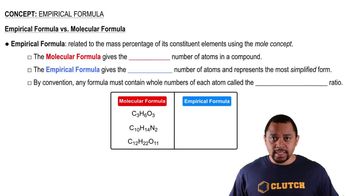
Empirical vs Molecular Formula
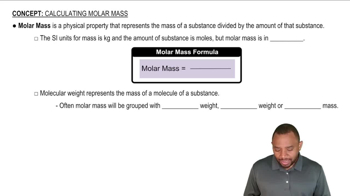
Molar Mass
Molar mass is the mass of one mole of a substance, typically expressed in grams per mole (g/mol). It is essential for converting the mass of elements in a sample to moles, which allows for the determination of the ratio of elements in the empirical formula. For iron (Fe), the molar mass is approximately 55.85 g/mol, and for oxygen (O), it is about 16.00 g/mol.
추천 영상:
가이드 코스
Molar Mass Concept
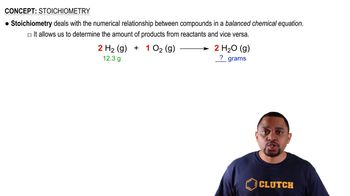
Stoichiometry
Stoichiometry is the branch of chemistry that deals with the quantitative relationships between the reactants and products in a chemical reaction. It involves using the mole concept and molar masses to calculate the amounts of substances involved. In this context, stoichiometry helps in determining the number of moles of iron and oxygen from their given masses, which is necessary for finding the empirical formula.
추천 영상:
가이드 코스
Stoichiometry Concept
관련 실천
교과서 질문
3
views
교과서 질문
At least 25 mg of tetrahydrocannabinol (THC), the active ingredient in marijuana, is required to produce intoxication. The molecular formula of THC is C21H30O2. How many molecules?
1759
views
교과서 질문
Give the empirical formula of each of the following compounds if a sample contains a.0.0130 mol C, 0.0390 mol H, and 0.0065 mol O
2
views
교과서 질문
The allowable concentration level of vinyl chloride, C2H3Cl, in the atmosphere in a chemical plant is 2.0×10⁻⁶ g/L. How many moles of vinyl chloride in each liter does this represent?
1334
views
교과서 질문
Determine the empirical formula of each of the following compounds if a sample contains a. 0.104 mol K, 0.052 mol C, and 0.156 mol O;
4
views
교과서 질문
Give the empirical formula of each of the following compounds if a sample contains c.40.0% C, 6.7% H, and 53.3% O by mass.
3
views