

Ch.3 - Chemical Reactions and Reaction Stoichiometry
Brown - Chemistry: The Central Science 15th Edition
Brown15th EditionChemistry: The Central ScienceISBN: 9780137542970당신이 사용하는 게 아니라요?교과서 변경
3장, 문제 35a

Calculate the following quantities: (a) mass, in grams, of 0.105 mol sucrose (C12H22O11)

검증된 단계별 안내
1
Determine the molar mass of sucrose (C_{12}H_{22}O_{11}) by adding the atomic masses of all the atoms in the formula.
Calculate the total molar mass: 12 carbon atoms, 22 hydrogen atoms, and 11 oxygen atoms.
Use the formula: mass (g) = moles × molar mass to find the mass of 0.105 mol of sucrose.
Substitute the values: 0.105 mol and the molar mass of sucrose into the formula.
Perform the multiplication to find the mass in grams.

비슷한 문제에 대한 검증된 영상 답변:

이 영상 해법은 위 문제에 도움이 된다고 튜터들이 추천한 것입니다.
영상 길이:
1m

주요 개념

질문에 올바르게 답하기 위해 반드시 이해해야 하는 핵심 개념들은 다음과 같습니다.

Molar Mass

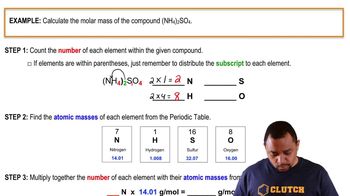
Molar mass is the mass of one mole of a substance, typically expressed in grams per mole (g/mol). It is calculated by summing the atomic masses of all the atoms in a molecule. For sucrose (C12H22O11), the molar mass can be determined by adding the molar masses of carbon, hydrogen, and oxygen in the given ratio.
추천 영상:
가이드 코스
02:11
Molar Mass Concept

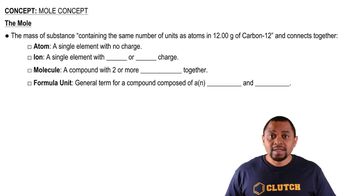
Mole Concept

The mole is a fundamental unit in chemistry that quantifies the amount of substance. One mole contains approximately 6.022 x 10^23 entities (Avogadro's number), which can be atoms, molecules, or ions. Understanding the mole concept is essential for converting between the number of particles and mass, allowing for calculations involving chemical reactions and stoichiometry.
추천 영상:

Mass Calculation

To calculate the mass of a substance from the number of moles, the formula used is: mass (g) = number of moles × molar mass (g/mol). This relationship allows chemists to determine how much of a substance is present in a given number of moles, which is crucial for preparing solutions and conducting reactions in the laboratory.
추천 영상:
가이드 코스
03:12
Molar Mass Calculation Example