Write balanced chemical equations corresponding to each of the following descriptions: c. Solid zinc metal reacts with sulfuric acid to form hydrogen gas and an aqueous solution of zinc sulfate.
Ch.3 - Chemical Reactions and Reaction Stoichiometry

3장, 문제 16d,e
Write balanced chemical equations to correspond to each of the following descriptions: (d) When solid mercury(II) nitrate is heated, it decomposes to form solid mercury(II) oxide, gaseous nitrogen dioxide, and oxygen. (e) Copper metal reacts with hot concentrated sulfuric acid solution to form aqueous copper(II) sulfate, sulfur dioxide gas, and water.
검증된 단계별 안내1
Identify the chemical formula for each compound: Mercury(II) nitrate is \( \text{Hg(NO}_3\text{)}_2 \), mercury(II) oxide is \( \text{HgO} \), nitrogen dioxide is \( \text{NO}_2 \), and oxygen is \( \text{O}_2 \).
Write the unbalanced chemical equation for the decomposition reaction: \( \text{Hg(NO}_3\text{)}_2 (s) \rightarrow \text{HgO} (s) + \text{NO}_2 (g) + \text{O}_2 (g) \).
Balance the equation by adjusting coefficients to ensure the same number of each type of atom on both sides of the equation.
Start by balancing the mercury atoms: There is 1 mercury atom on both sides, so they are balanced.
Next, balance the nitrogen and oxygen atoms by adjusting the coefficients of \( \text{NO}_2 \) and \( \text{O}_2 \) to ensure the total number of nitrogen and oxygen atoms are equal on both sides.

비슷한 문제에 대한 검증된 영상 답변:
이 영상 해법은 위 문제에 도움이 된다고 튜터들이 추천한 것입니다.
영상 길이:
2m주요 개념
질문에 올바르게 답하기 위해 반드시 이해해야 하는 핵심 개념들은 다음과 같습니다.
Decomposition Reactions
Decomposition reactions occur when a single compound breaks down into two or more simpler products. In this case, solid mercury(II) nitrate decomposes upon heating, which is a common characteristic of many metal nitrates. Understanding this type of reaction is essential for predicting the products formed during the heating process.
추천 영상:
가이드 코스
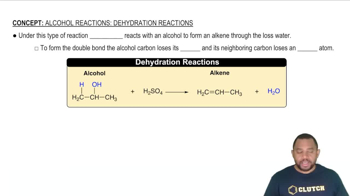
Alcohol Reactions: Dehydration Reactions
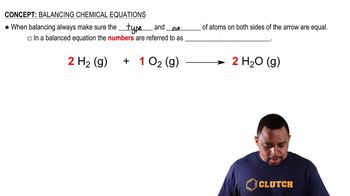
Balancing Chemical Equations
Balancing chemical equations is the process of ensuring that the number of atoms for each element is the same on both sides of the equation. This is based on the law of conservation of mass, which states that matter cannot be created or destroyed in a chemical reaction. Proper balancing is crucial for accurately representing the reaction and its stoichiometry.
추천 영상:
가이드 코스
Balancing Chemical Equations
Products of Thermal Decomposition
The thermal decomposition of certain compounds can yield specific products, often including oxides, gases, or other simpler compounds. In the case of mercury(II) nitrate, heating leads to the formation of mercury(II) oxide, nitrogen dioxide, and oxygen. Recognizing the typical products of thermal decomposition helps in predicting the outcomes of similar reactions.
추천 영상:
가이드 코스
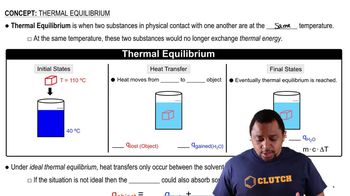
Thermal Equilibrium
관련 실천
교과서 질문
2
views
교과서 질문
Write balanced chemical equations to correspond to each of the following descriptions: (a) When sulfur trioxide gas reacts with water, a solution of sulfuric acid forms. (b) Boron sulfide, B2S3(s), reacts violently with water to form dissolved boric acid, H3BO3, and hydrogen sulfide gas.
879
views
교과서 질문
(b) What products form in this reaction?
447
views
교과서 질문
Write balanced chemical equations to correspond to each of the following descriptions: (c) Phosphine, PH3(g), combusts in oxygen gas to form water vapor and solid tetraphosphorus decaoxide.
509
views
교과서 질문
(a) When a compound containing C, H, and O is completely combusted in air, what reactant besides the hydrocarbon is involved in the reaction?
1254
views