Ch.5 - Thermochemistry
Brown - Chemistry: The Central Science 15th Edition
Brown15th EditionChemistry: The Central ScienceISBN: 9780137542970당신이 사용하는 게 아니라요?교과서 변경
5장, 문제 64

From the enthalpies of reaction 2 C(s) + O2(g) → 2 CO(g) ΔH = -221.0 kJ 2 C(s) + O2(g) + 4 H2(g) → 2 CH3OH(g) ΔH = -402.4 kJ Calculate ΔH for the reaction CO(g) + 2 H2(g) → CH3OH(g)

검증된 단계별 안내
1
Identify the target reaction: CO(g) + 2 H_2(g) → CH_3OH(g).
Use Hess's Law, which states that the total enthalpy change for a reaction is the same, no matter how many steps the reaction is carried out in.
Write the given reactions and their enthalpy changes: 1) 2 C(s) + O_2(g) → 2 CO(g), ΔH = -221.0 kJ; 2) 2 C(s) + O_2(g) + 4 H_2(g) → 2 CH_3OH(g), ΔH = -402.4 kJ.
Manipulate the given reactions to derive the target reaction. Divide both given reactions by 2 to match the stoichiometry of the target reaction.
Subtract the enthalpy of the first reaction from the second to find the enthalpy change for the target reaction.

비슷한 문제에 대한 검증된 영상 답변:

이 영상 해법은 위 문제에 도움이 된다고 튜터들이 추천한 것입니다.
영상 길이:
3m

주요 개념

질문에 올바르게 답하기 위해 반드시 이해해야 하는 핵심 개념들은 다음과 같습니다.

Enthalpy of Reaction

Enthalpy of reaction (ΔH) is the heat change associated with a chemical reaction at constant pressure. It indicates whether a reaction is exothermic (releases heat, ΔH < 0) or endothermic (absorbs heat, ΔH > 0). Understanding ΔH is crucial for predicting the energy changes during reactions and for applying Hess's law to calculate unknown enthalpies.
추천 영상:
가이드 코스
02:34
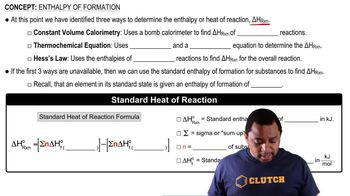
Enthalpy of Formation

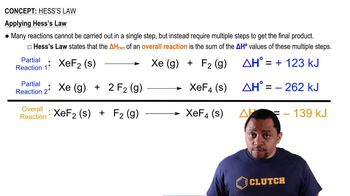
Hess's Law

Hess's Law states that the total enthalpy change for a reaction is the sum of the enthalpy changes for individual steps, regardless of the pathway taken. This principle allows chemists to calculate the enthalpy change for a reaction that may be difficult to measure directly by using known enthalpy changes of related reactions.
추천 영상:

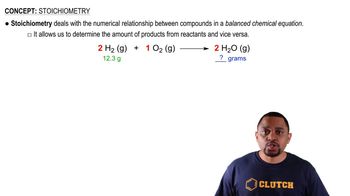
Stoichiometry in Reactions

Stoichiometry involves the quantitative relationships between the reactants and products in a chemical reaction. It is essential for balancing chemical equations and determining the amounts of substances consumed or produced. In this context, stoichiometry helps in relating the enthalpy changes of the given reactions to find the ΔH for the target reaction.
추천 영상:
가이드 코스
01:16
Stoichiometry Concept
관련 실천
교과서 질문

Given the data N2(g) + O2(g) → 2 NO(g) ΔH = +180.7 kJ 2 NO(g) + O2(g) → 2 NO2(g) ΔH = -113.1 kJ 2 N2O(g) → 2 N2(g) + O2(g) ΔH = -163.2 kJ use Hess's law to calculate ΔH for the reaction N2O(g) + NO2(g) → 3 NO(g)

894
views

교과서 질문

Under constant-volume conditions, the heat of combustion of benzoic acid (C6H5COOH) is 26.38 kJ/g. A 2.760-g sample of benzoic acid is burned in a bomb calorimeter. The temperature of the calorimeter increases from 21.60 to 29.93 °C. c. Suppose that in changing samples, a portion of the water in the calorimeter were lost. In what way, if any, would this change the heat capacity of the calorimeter?

2
views
교과서 질문

The concentration of alcohol 1CH3CH2OH2 in blood, called the 'blood alcohol concentration' or BAC, is given in units of grams of alcohol per 100 mL of blood. The legal definition of intoxication, in many states of the United States, is that the BAC is 0.08 or higher. What is the concentration of alcohol, in terms of molarity, in blood if the BAC is 0.08?

2404
views
교과서 질문

Calculate the enthalpy change for the reaction P4O6(s) + 2 O2(g) → P4O10(s) given the following enthalpies of reaction: P4(s) + 3 O2(g) → P4O6(s) ΔH = -1640.1 kJ P4(s) + 5 O2(g) → P4O10(s) ΔH = -2940.1 kJ

1298
views
교과서 질문

Consider the following hypothetical reactions: A → B ΔH = +30 kJ B → C ΔH = +60 kJ (b) Construct an enthalpy diagram for substances A, B, and C, and show how Hess's law applies.

3
views
교과서 질문

We can use Hess's law to calculate enthalpy changes that cannot be measured. One such reaction is the conversion of methane to ethane: 2 CH4(g) → C2H6(g) + H2(g) Calculate the ΔH° for this reaction using the following thermochemical data: CH4(g) + 2 O2(g) → CO2(g) + 2 H2O(l) ΔH° = -890.3 kJ 2 H2(g) + O2(g) → 2 H2O(l) H° = -571.6 kJ 2 C2H6(g) + 7 O2(g) → 4 CO2(g) + 6 H2O(l) ΔH° = -3120.8 kJ

1171
views