

Ch.5 - Thermochemistry
Brown - Chemistry: The Central Science 15th Edition
Brown15th EditionChemistry: The Central ScienceISBN: 9780137542970당신이 사용하는 게 아니라요?교과서 변경
5장, 문제 120

The Sun supplies about 1.0 kilowatt of energy for each square meter of surface area (1.0 kW/m2, where a watt=1 J/s). Plants produce the equivalent of about 0.20 g of sucrose (C12H22O11) per hour per square meter. Assuming that the sucrose is produced as follows, calculate the percentage of sunlight used to produce sucrose. 12 CO2(g) + 11 H2O(l) → C12H22O11 + 12 O2(g) H = 5645 kJ

검증된 단계별 안내
1
Identify the energy input from the Sun: The Sun provides 1.0 kW/m^2, which is equivalent to 1000 J/s per square meter. Since the sucrose production is measured per hour, convert this to energy per hour by multiplying by the number of seconds in an hour (3600 s).
Calculate the energy output in the form of sucrose: Determine the energy content of 0.20 g of sucrose using the given enthalpy change (ΔH = 5645 kJ) for the reaction. First, find the molar mass of sucrose (C12H22O11) by adding the atomic masses of its constituent atoms.
Convert the mass of sucrose produced (0.20 g) to moles by dividing by the molar mass of sucrose. Then, calculate the energy content of this amount of sucrose using the enthalpy change of the reaction.
Determine the percentage of sunlight energy used: Divide the energy content of the sucrose produced by the total solar energy input per hour, and multiply by 100 to express it as a percentage.
Summarize the calculation: The percentage of sunlight energy used to produce sucrose is the ratio of the energy stored in the sucrose to the total solar energy received, expressed as a percentage.

비슷한 문제에 대한 검증된 영상 답변:

이 영상 해법은 위 문제에 도움이 된다고 튜터들이 추천한 것입니다.
영상 길이:
5m

주요 개념

질문에 올바르게 답하기 위해 반드시 이해해야 하는 핵심 개념들은 다음과 같습니다.

Photosynthesis

Photosynthesis is the biochemical process by which green plants, algae, and some bacteria convert light energy into chemical energy, specifically in the form of glucose or sucrose. The overall reaction involves the absorption of carbon dioxide and water, using sunlight to produce glucose and oxygen. This process is essential for life on Earth as it forms the basis of the food chain and contributes to the oxygen content of the atmosphere.
추천 영상:
가이드 코스
03:05
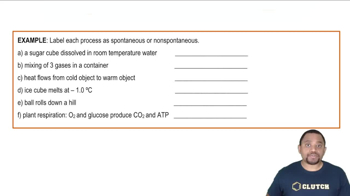
Spontaneity of Processes Example

Energy Conversion Efficiency

Energy conversion efficiency refers to the ratio of useful energy output to the total energy input, often expressed as a percentage. In the context of photosynthesis, it measures how effectively plants convert sunlight into chemical energy stored in sucrose. Understanding this concept is crucial for calculating the percentage of sunlight utilized in the production of sucrose from the given energy input.
추천 영상:
가이드 코스
01:56
Conversion Factors

Thermochemical Equation

A thermochemical equation represents a chemical reaction along with the associated enthalpy change, indicating the heat absorbed or released during the reaction. In this case, the equation for photosynthesis includes the enthalpy change (ΔH = -5645 kJ) which indicates the energy required to produce sucrose from carbon dioxide and water. This information is vital for calculating the energy used from sunlight in the production of sucrose.
추천 영상:
가이드 코스
01:13
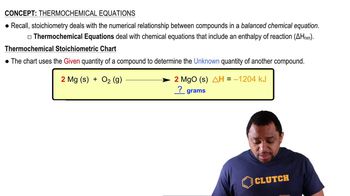
Thermochemical Equations