Ch.7 - Periodic Properties of the Elements
Brown - Chemistry: The Central Science 15th Edition
Brown15th EditionChemistry: The Central ScienceISBN: 9780137542970당신이 사용하는 게 아니라요?교과서 변경
7장, 문제 40

Which of the ions Ni2+, Fe2+, Co3+, and Pt2+ has an electron configuration of 𝑛𝑑6(𝑛=3,4,5,…)?
a. Ni2+
b. Fe2+
c. Co3+
d. Pt2+
e. More than one of these

검증된 단계별 안내
1
insert step 1> Determine the electron configuration of the neutral atoms: Ni, Fe, Co, and Pt. For transition metals, the general order is to fill the 4s orbital before the 3d orbital.
insert step 2> For each ion, remove electrons starting from the outermost shell, which is typically the s orbital, followed by the d orbital if necessary.
insert step 3> Calculate the electron configuration for each ion: Ni^{2+}, Fe^{2+}, Co^{3+}, and Pt^{2+}.
insert step 4> Identify which ion has an electron configuration ending in nd^6.
insert step 5> Compare the electron configurations to determine if more than one ion has the nd^6 configuration.

비슷한 문제에 대한 검증된 영상 답변:

이 영상 해법은 위 문제에 도움이 된다고 튜터들이 추천한 것입니다.
영상 길이:
6m

주요 개념

질문에 올바르게 답하기 위해 반드시 이해해야 하는 핵심 개념들은 다음과 같습니다.

Electron Configuration

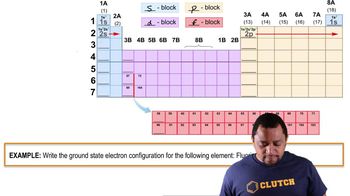
Electron configuration describes the distribution of electrons in an atom's orbitals. It is represented using a notation that indicates the energy levels and sublevels occupied by electrons. For transition metals, the d-orbitals play a significant role, and understanding how to write and interpret these configurations is essential for predicting chemical behavior and properties.
추천 영상:
가이드 코스
01:33
Electron Configuration Example

Oxidation States

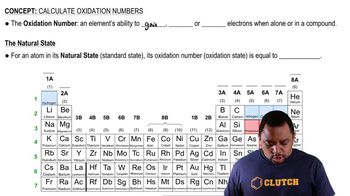
Oxidation states indicate the degree of oxidation of an atom in a compound, reflecting the number of electrons lost or gained. Transition metals can exhibit multiple oxidation states, which affects their electron configurations. Knowing the oxidation state of an ion helps in determining its electron configuration, especially for ions like Ni2+, Fe2+, Co3+, and Pt2+.
추천 영상:
가이드 코스
02:42
Oxidation Numbers

d-Orbital Filling

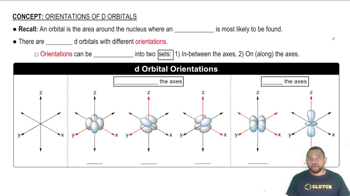
The d-orbitals are filled according to specific rules, including the Aufbau principle, Hund's rule, and the Pauli exclusion principle. For transition metals, the filling of d-orbitals is crucial for understanding their chemical properties and electron configurations. The notation 𝑛𝑑6 indicates that there are six electrons in the d-orbitals, which is key to identifying the correct ion from the given options.
추천 영상:
가이드 코스
02:06
d Orbital Orientations