Ch.8 - Basic Concepts of Chemical Bonding
Brown - Chemistry: The Central Science 15th Edition
Brown15th EditionChemistry: The Central ScienceISBN: 9780137542970당신이 사용하는 게 아니라요?교과서 변경
8장, 문제 43

Which of the following bonds are polar: a. B—F, b. Cl—Cl, c. Se—O, d. H—I? Which is the more electronegative atom in each polar bond?

검증된 단계별 안내
1
insert step 1> Determine the electronegativity of each atom in the bonds: B, F, Cl, Se, O, H, and I.
insert step 2> Compare the electronegativity values of the atoms in each bond to determine if there is a significant difference.
insert step 3> Identify the bonds with a significant difference in electronegativity as polar bonds.
insert step 4> For each polar bond, identify the atom with the higher electronegativity as the more electronegative atom.
insert step 5> List the polar bonds and the more electronegative atom in each.

비슷한 문제에 대한 검증된 영상 답변:

이 영상 해법은 위 문제에 도움이 된다고 튜터들이 추천한 것입니다.
영상 길이:
4m

주요 개념

질문에 올바르게 답하기 위해 반드시 이해해야 하는 핵심 개념들은 다음과 같습니다.

Electronegativity

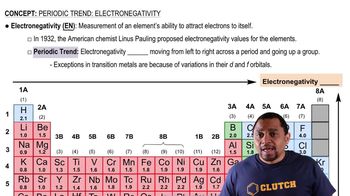
Electronegativity is a measure of an atom's ability to attract and hold onto electrons in a chemical bond. It varies across the periodic table, with elements like fluorine being highly electronegative. In a bond between two different atoms, the atom with higher electronegativity will attract the shared electrons more strongly, leading to a polar bond.
추천 영상:
가이드 코스
02:10
Electronegativity Trends

Polar Bonds

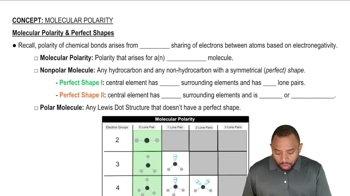
A polar bond occurs when there is a significant difference in electronegativity between the two atoms involved in the bond. This difference causes an uneven distribution of electron density, resulting in a dipole moment where one end of the bond is slightly negative and the other slightly positive. Bonds such as B-F and Se-O are examples of polar bonds due to the differing electronegativities of the atoms.
추천 영상:
가이드 코스
02:38
Molecular Polarity

Bond Types

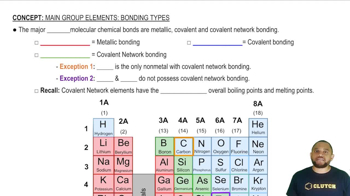
Bonds can be classified as polar or nonpolar based on the electronegativity difference between the bonded atoms. Nonpolar bonds, like Cl-Cl, occur between identical atoms where electron sharing is equal. Understanding the type of bond helps predict molecular behavior, reactivity, and interactions with other molecules, which is crucial in chemistry.
추천 영상: