Ch.1 - Chemical Tools: Experimentation & Measurement
McMurry - Chemistry 8th Edition
McMurry8th EditionChemistryISBN: 9781292336145당신이 사용하는 게 아니라요?교과서 변경
1장, 문제 60

Sodium chloride has a melting point of 1074 K and a boil-ing point of 1686 K. Convert these temperatures to degrees Celsius and to degrees Fahrenheit.

검증된 단계별 안내
1
Start by converting the melting point from Kelvin to Celsius using the formula: \( T_{\text{C}} = T_{\text{K}} - 273.15 \).
Apply the formula to the melting point: \( T_{\text{C, melting}} = 1074 - 273.15 \).
Next, convert the boiling point from Kelvin to Celsius using the same formula: \( T_{\text{C, boiling}} = 1686 - 273.15 \).
Convert the melting point from Celsius to Fahrenheit using the formula: \( T_{\text{F}} = \frac{9}{5}T_{\text{C}} + 32 \).
Apply the formula to the boiling point: \( T_{\text{F, boiling}} = \frac{9}{5}T_{\text{C, boiling}} + 32 \).

비슷한 문제에 대한 검증된 영상 답변:

이 영상 해법은 위 문제에 도움이 된다고 튜터들이 추천한 것입니다.
영상 길이:
5m

주요 개념

질문에 올바르게 답하기 위해 반드시 이해해야 하는 핵심 개념들은 다음과 같습니다.

Temperature Conversion

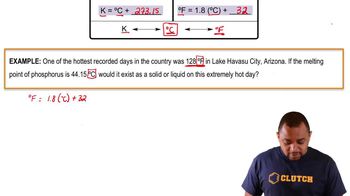
Temperature can be expressed in different scales, primarily Celsius (°C), Fahrenheit (°F), and Kelvin (K). To convert from Kelvin to Celsius, subtract 273.15 from the Kelvin temperature. For Fahrenheit, the conversion from Celsius involves multiplying by 9/5 and then adding 32. Understanding these formulas is essential for accurately converting temperatures.
추천 영상:
가이드 코스
02:10
Temperature Conversion Example

Melting and Boiling Points

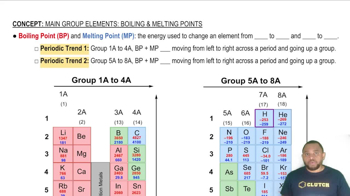
The melting point is the temperature at which a solid becomes a liquid, while the boiling point is the temperature at which a liquid turns into vapor. For sodium chloride, these points indicate the temperatures at which it transitions between solid, liquid, and gas phases. Recognizing these points helps in understanding the physical properties of substances and their behavior under different temperature conditions.
추천 영상:
가이드 코스
04:29
Boiling Point and Melting Point

Phase Changes

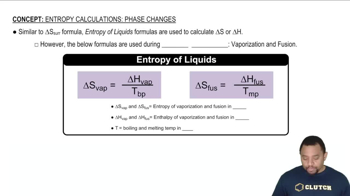
Phase changes refer to the transitions between solid, liquid, and gas states of matter, driven by temperature and pressure. During melting, a solid absorbs heat and changes to a liquid, while boiling involves a liquid absorbing heat to become a gas. These concepts are crucial for understanding the thermal properties of substances like sodium chloride and how they respond to temperature changes.
추천 영상:
가이드 코스
01:46
Entropy in Phase Changes
관련 실천
교과서 질문
What is the volume in L of a cube with an edge length of 7.0 dm?
786
views

교과서 질문

Suppose you were dissatisfied with both Celsius and Fahrenheit units and wanted to design your own temperature scale based on ethyl alcohol (ethanol). On the Celsius scale, ethanol has a melting point of -117.3 °C and a boiling point of 78.5 °C, but on your new scale calibrated in units of degrees ethanol, °E, you define ethanol to melt at 0 °E and boil at 200 °E. (c) What are the melting and boiling points of water on the ethanol scale?

1555
views
교과서 질문

Suppose you were dissatisfied with both Celsius and Fahrenheit units and wanted to design your own temperature scale based on ethyl alcohol (ethanol). On the Celsius scale, ethanol has a melting point of -117.3 °C and a boiling point of 78.5 °C, but on your new scale calibrated in units of degrees ethanol, °E, you define ethanol to melt at 0 °E and boil at 200 °E. (d) What is normal human body temperature (98.6 °F) on the ethanol scale?

967
views
교과서 질문

Suppose you were dissatisfied with both Celsius and Fahrenheit units and wanted to design your own temperature scale based on ethyl alcohol (ethanol). On the Celsius scale, ethanol has a melting point of -117.3 °C and a boiling point of 78.5 °C, but on your new scale calibrated in units of degrees ethanol, °E, you define ethanol to melt at 0 °E and boil at 200 °E. (e) If the outside thermometer reads 130 °E, how would you dress to go out?

514
views
교과서 질문
What is the difference between a derived SI unit and a funda-mental SI unit? Give an example of each
780
views
교과서 질문
A 125 mL sample of water at 293.2 K was heated for 8 min, 25 s so as to give a constant temperature increase of 3.0 °F/min. What is the final temperature of the water in degrees Celsius?
739
views
1
rank