A small cylinder of helium gas used for filling balloons has
a volume of 2.30 L and a pressure of 13,800 kPa at 25 °C.
How many balloons can you fill if each one has a volume of
1.5 L and a pressure of 1.25 atm at 25 °C?
검증된 단계별 안내
1
Convert the initial pressure of the helium gas from kPa to atm, knowing that 1 atm = 101.325 kPa.
Use the ideal gas law, PV = nRT, to calculate the number of moles (n) of helium in the cylinder. Assume R = 0.0821 L atm / (mol K) and convert the temperature from Celsius to Kelvin by adding 273.15.
Calculate the total number of moles of helium required to fill one balloon using the ideal gas law, with the volume and pressure given for the balloon and the same temperature and R value.
Divide the total number of moles of helium in the cylinder by the number of moles required to fill one balloon to find out how many balloons can be filled.
Ensure that all units match when performing calculations, especially the units of pressure (atm), volume (L), and temperature (K).
비슷한 문제에 대한 검증된 영상 답변:
이 영상 해법은 위 문제에 도움이 된다고 튜터들이 추천한 것입니다.
영상 길이:
3m
영상 재생:
0 댓글
주요 개념
질문에 올바르게 답하기 위해 반드시 이해해야 하는 핵심 개념들은 다음과 같습니다.
Ideal Gas Law
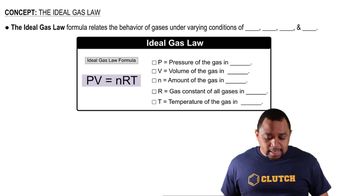
The Ideal Gas Law relates the pressure, volume, temperature, and number of moles of a gas through the equation PV = nRT. This law is essential for understanding how gases behave under different conditions and allows for the calculation of one variable when the others are known.
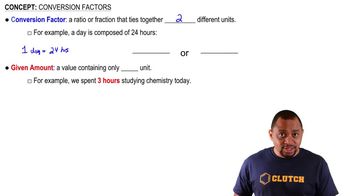
Unit conversion is crucial in chemistry to ensure that all measurements are in compatible units. In this question, pressures are given in kPa and atm, and volumes in liters, necessitating conversions to apply the Ideal Gas Law correctly and compare the gas conditions.
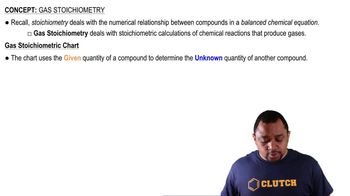
Gas stoichiometry involves using the relationships between the amounts of reactants and products in a chemical reaction, particularly for gases. In this scenario, it helps determine how many balloons can be filled by calculating the total volume of helium available and comparing it to the volume required for each balloon.

 검증된 단계별 안내

 01:15