


Ch.10 - Gases: Their Properties & Behavior
McMurry - Chemistry 8th Edition
McMurry8th EditionChemistryISBN: 9781292336145당신이 사용하는 게 아니라요?교과서 변경
10장, 문제 77

Assume that you have 1.00 g of nitroglycerin in a 500.0-mL steel container at 20.0 °C and 1.00 atm pressure. An explosion occurs, raising the temperature of the container and its contents to 425 °C. The balanced equation is 4 C3H5N3O91l2¡ 12 CO21g2 + 10 H2O1g2 + 6 N21g2 + O21g2 (c) What is the pressure in atmospheres inside the container after the explosion according to the ideal gas law?

검증된 단계별 안내
1
First, write down the balanced chemical equation for the explosion of nitroglycerin: 4 C3H5N3O9(l) → 12 CO2(g) + 10 H2O(g) + 6 N2(g) + O2(g).
Calculate the number of moles of nitroglycerin initially present using its molar mass. The molar mass of C3H5N3O9 is approximately 227 g/mol.
Using stoichiometry, determine the total moles of gas produced from the reaction. For every 4 moles of nitroglycerin, 29 moles of gas are produced (12 moles of CO2, 10 moles of H2O, 6 moles of N2, and 1 mole of O2).
Apply the ideal gas law, PV = nRT, where P is the pressure, V is the volume, n is the number of moles of gas, R is the ideal gas constant (0.0821 L atm/mol K), and T is the temperature in Kelvin. Convert the temperature from Celsius to Kelvin by adding 273.15.
Solve for the pressure P after the explosion by substituting the values of n, V, R, and T into the ideal gas law equation.

비슷한 문제에 대한 검증된 영상 답변:

이 영상 해법은 위 문제에 도움이 된다고 튜터들이 추천한 것입니다.
영상 길이:
9m

주요 개념

질문에 올바르게 답하기 위해 반드시 이해해야 하는 핵심 개념들은 다음과 같습니다.

Ideal Gas Law

The Ideal Gas Law is a fundamental equation in chemistry that relates the pressure, volume, temperature, and number of moles of a gas. It is expressed as PV = nRT, where P is pressure, V is volume, n is the number of moles, R is the ideal gas constant, and T is temperature in Kelvin. This law allows us to predict the behavior of gases under various conditions, making it essential for calculating the pressure after a reaction.
추천 영상:
가이드 코스
01:15
Ideal Gas Law Formula

Stoichiometry

Stoichiometry is the area of chemistry that deals with the quantitative relationships between the reactants and products in a chemical reaction. It involves using balanced chemical equations to determine the amounts of substances consumed and produced. In the context of the explosion, stoichiometry helps to calculate the moles of gases generated from the decomposition of nitroglycerin, which is crucial for applying the Ideal Gas Law.
추천 영상:
가이드 코스
01:16
Stoichiometry Concept

Temperature Conversion

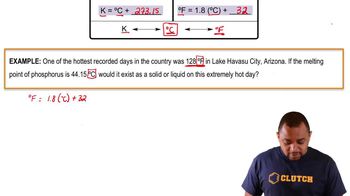
Temperature conversion is the process of changing temperature from one scale to another, commonly from Celsius to Kelvin in scientific calculations. The Kelvin scale is used in gas law calculations because it is an absolute scale, starting at absolute zero. To convert Celsius to Kelvin, you add 273.15 to the Celsius temperature. This conversion is necessary to accurately apply the Ideal Gas Law after the explosion, as the temperature must be in Kelvin.
추천 영상:
가이드 코스
02:10
Temperature Conversion Example