

Ch.10 - Gases: Their Properties & Behavior
McMurry - Chemistry 8th Edition
McMurry8th EditionChemistryISBN: 9781292336145당신이 사용하는 게 아니라요?교과서 변경
10장, 문제 89a

Chlorine gas was first prepared in 1774 by the oxidation of NaCl with MnO2: 2 NaCl(s) + 2 H2SO4(l) + MnO2(s) → Na2SO4(s) + MnSO4(s) + 2 H2O(g) + Cl2(g) Assume that the gas produced is saturated with water vapor at a partial pressure of 28.7 mm Hg and that it has a volume of 0.597 L at 27 °C and 755 mm Hg pressure. (a) What is the mole fraction of Cl2 in the gas?

검증된 단계별 안내
1
Convert the temperature from Celsius to Kelvin by adding 273.15 to the Celsius temperature. This is necessary for calculations involving gases which require absolute temperature in Kelvin.
Calculate the total pressure of the dry gas by subtracting the partial pressure of the water vapor from the total pressure of the gas mixture.
Use the ideal gas law, PV = nRT, to find the number of moles of dry gas. Here, P is the pressure of the dry gas, V is the volume, R is the ideal gas constant (0.0821 L atm K-1 mol-1), and T is the temperature in Kelvin.
Calculate the partial pressure of Cl2 by subtracting the partial pressure of water vapor from the total pressure of the gas mixture.
Determine the mole fraction of Cl2 by dividing the partial pressure of Cl2 by the total pressure of the dry gas.

비슷한 문제에 대한 검증된 영상 답변:

이 영상 해법은 위 문제에 도움이 된다고 튜터들이 추천한 것입니다.
영상 길이:
3m

주요 개념

질문에 올바르게 답하기 위해 반드시 이해해야 하는 핵심 개념들은 다음과 같습니다.

Ideal Gas Law

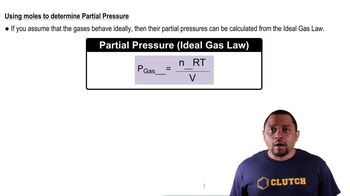
The Ideal Gas Law relates the pressure, volume, temperature, and number of moles of a gas through the equation PV = nRT. This law is essential for calculating the behavior of gases under various conditions. In this question, it helps determine the number of moles of Cl2 and water vapor present in the gas mixture.
추천 영상:
가이드 코스
01:15
Ideal Gas Law Formula

Partial Pressure

Partial pressure is the pressure exerted by a single component of a gas mixture. According to Dalton's Law, the total pressure of a gas mixture is the sum of the partial pressures of its individual components. Understanding partial pressure is crucial for calculating the mole fraction of Cl2, as it allows us to separate the contributions of Cl2 and water vapor to the total pressure.
추천 영상:
가이드 코스
00:48
Partial Pressure Calculation

Mole Fraction

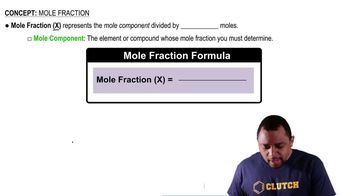
Mole fraction is a way of expressing the concentration of a component in a mixture, defined as the ratio of the number of moles of that component to the total number of moles in the mixture. It is a dimensionless quantity that provides insight into the composition of gas mixtures. In this problem, calculating the mole fraction of Cl2 requires knowing the moles of Cl2 and the total moles of gas present, including water vapor.
추천 영상:
가이드 코스
00:36
Mole Fraction Formula
관련 실천
교과서 질문

Natural gas is a mixture of hydrocarbons, primarily methane 1CH42 and ethane 1C2H62. A typical mixture might have Xmethane = 0.915 and Xethane = 0.085. Let's assume that we have a 15.50 g sample of natural gas in a volume of 15.00 L at a temperature of 20.00 °C. (a) How many total moles of gas are in the sample?

464
views
교과서 질문

A mixture of 14.2 g of H2 and 36.7 g of Ar is placed in a 100.0-L container at 290 K. (b) What is the partial pressure of Ar in atmospheres?

422
views
교과서 질문

Chlorine gas was first prepared in 1774 by the oxidation of NaCl with MnO2: 2 NaCl(s) + 2 H2SO4(l) + MnO2(s) → Na2SO4(s) + MnSO4(s) + 2 H2O(g) + Cl2(g) Assume that the gas produced is saturated with water vapor at a partial pressure of 28.7 mm Hg and that it has a volume of 0.597 L at 27 °C and 755 mm Hg pressure. (b) How many grams of NaCl were used in the experiment, assuming complete reaction?

604
views
교과서 질문
A 20.0-L flask contains 0.776 g of He and 3.61 g of CO2 at 300 K. (a) What is the partial pressure of He in mm Hg?
632
views
교과서 질문

Natural gas is a mixture of hydrocarbons, primarily methane (CH4) and ethane (C2H6). A typical mixture might have Xmethane = 0.915 and Xethane = 0.085. Let's assume that we have a 15.50 g sample of natural gas in a volume of 15.00 L at a temperature of 20.00 °C. (b) What is the pressure of the sample in atmospheres?

1359
views
교과서 질문
A sample of magnesium metal reacts with aqueous HCl to yield H2 gas: Mg1s2 + 2 HCl1aq2¡MgCl21aq2 + H21g2 The gas that forms is found to have a volume of 3.557 L at 25 °C and a pressure of 747 mm Hg. Assuming that the gas is saturated with water vapor at a partial pressure of 23.8 mm Hg, what is the partial pressure in millimeters of mercury of the H2? How many grams of magnesium metal were used in the reaction?
1183
views