Ch.10 - Gases: Their Properties & Behavior
McMurry - Chemistry 8th Edition
McMurry8th EditionChemistryISBN: 9781292336145당신이 사용하는 게 아니라요?교과서 변경
10장, 문제 74

The reaction of sodium peroxide 1Na2O22 with CO2 is used in space vehicles to remove CO2 from the air and generate O2 for breathing: 2 Na2O21s2 + 2 CO21g2¡2 Na2CO31s2 + O21g2 (a) Assuming that air is breathed at an average rate of 4.50 L/min (25 °C; 735 mm Hg) and that the concentration of CO2 in expelled air is 3.4% by volume, how many grams of CO2 are produced in 24 h?

검증된 단계별 안내
1
Calculate the total volume of air expelled in 24 hours by multiplying the breathing rate (4.50 L/min) by the number of minutes in 24 hours (24 * 60).
Determine the volume of CO2 in the expelled air by taking 3.4% of the total volume of air expelled.
Use the ideal gas law, PV = nRT, to calculate the number of moles of CO2. Convert the pressure from mm Hg to atm, use the volume of CO2 from step 2, and use R = 0.0821 L·atm/mol·K with the temperature converted to Kelvin.
Convert the moles of CO2 to grams using the molar mass of CO2 (44.01 g/mol).
Summarize the process to ensure understanding: calculate total air volume, find CO2 volume, use ideal gas law for moles, and convert moles to grams.

비슷한 문제에 대한 검증된 영상 답변:

이 영상 해법은 위 문제에 도움이 된다고 튜터들이 추천한 것입니다.
영상 길이:
5m

주요 개념

질문에 올바르게 답하기 위해 반드시 이해해야 하는 핵심 개념들은 다음과 같습니다.

Stoichiometry

Stoichiometry is the calculation of reactants and products in chemical reactions based on the balanced chemical equation. It allows us to determine the relationships between the quantities of substances involved in a reaction. In this question, stoichiometry will help us relate the volume of CO2 produced from the reaction to the mass of CO2 expelled in the air.
추천 영상:
가이드 코스
01:16
Stoichiometry Concept

Gas Laws

Gas laws describe the behavior of gases in relation to pressure, volume, and temperature. The Ideal Gas Law (PV=nRT) is particularly useful for converting between the volume of gas and the number of moles. In this scenario, understanding how to apply gas laws will be essential for calculating the amount of CO2 in the air based on its concentration and the volume of air breathed.
추천 영상:
가이드 코스
01:43
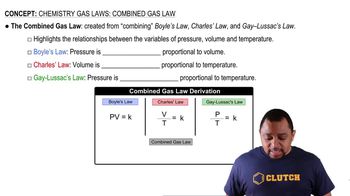
Combined Gas Law

Molar Mass

Molar mass is the mass of one mole of a substance, typically expressed in grams per mole (g/mol). It is crucial for converting between the number of moles of a substance and its mass. In this problem, knowing the molar mass of CO2 will allow us to convert the calculated moles of CO2 produced from the volume of air into grams, providing the final answer.
추천 영상:
가이드 코스
02:11
Molar Mass Concept
관련 실천
교과서 질문
Ammonium nitrate can decompose explosively when heated according to the equation 2 NH4NO31s2¡2 N21g2 + 4 H2O1g2 + O21g2 How many liters of gas would be formed at 450 °C and 1.00 atm pressure by explosion of 450 g of NH4NO3?
939
views

교과서 질문

Titanium(III) chloride, a substance used in catalysts for preparing polyethylene, is made by high-temperature reaction of TiCl4 vapor with H2: 2 TiCl4(g) + H2(g) → 2 TiCl3(s) + 2 HCl(g) (b) How many liters of HCl gas at STP will result from the reaction described in part (a)?

385
views
교과서 질문

Hydrogen gas can be prepared by reaction of zinc metal with aqueous HCl: Zn(s) + 2 HCl(aq) ¡ ZnCl2(aq) + H2(g) (a) How many liters of H2 would be formed at 742 mm Hg and 15 °C if 25.5 g of zinc was allowed to react?

658
views
교과서 질문
A typical high-pressure tire on a bicycle might have a volume of 365 mL and a pressure of 7.80 atm at 25 °C. Suppose the rider filled the tire with helium to minimize weight. What is the mass of the helium in the tire?
1394
views
교과서 질문

Hydrogen gas can be prepared by reaction of zinc metal with aqueous HCl: Zn(s) + 2 HCl(aq) ¡ ZnCl2(aq) + H2(g) (b) How many grams of zinc would you start with if you wanted to prepare 5.00 L of H2 at 350 mm Hg and 30.0 °C?

960
views
교과서 질문

Titanium(III) chloride, a substance used in catalysts for preparing polyethylene, is made by high-temperature reaction of TiCl4 vapor with H2: 2 TiCl4(g) + H2(g) → 2 TiCl3(s) + 2 HCl(g) (a) How many grams of TiCl4 are needed for complete reaction with 155 L of H2 at 435 °C and 795 mm Hg pressure?

674
views