Ch.11 - Liquids & Phase Changes
McMurry - Chemistry 8th Edition
McMurry8th EditionChemistryISBN: 9781292336145당신이 사용하는 게 아니라요?교과서 변경
11장, 문제 46

How much energy in kilojoules is needed to heat 5.00 g of ice from -11.0 °C to °30.0 °C? The heat of fusion of water is 6.01 kJ>mol, and the m# olar heat capacity is 36.01 kJ>mol for ice and 75.4 J/K mol2 for liquid water

검증된 단계별 안내
1
Calculate the amount of ice in moles by using its molar mass. The molar mass of water (H2O) is approximately 18.015 g/mol.
First, calculate the energy required to heat the ice from -11.0 °C to 0 °C using the formula: \( q = n \times C_{ice} \times \Delta T \), where \( q \) is the heat energy, \( n \) is the number of moles of ice, \( C_{ice} \) is the molar heat capacity of ice, and \( \Delta T \) is the change in temperature.
Next, calculate the energy required to melt the ice at 0 °C to water at 0 °C using the heat of fusion formula: \( q = n \times \Delta H_{fus} \), where \( \Delta H_{fus} \) is the heat of fusion of water.
Then, calculate the energy required to heat the water from 0 °C to 30.0 °C using the formula: \( q = n \times C_{water} \times \Delta T \), where \( C_{water} \) is the molar heat capacity of liquid water.
Finally, sum up all the calculated energies to find the total energy required to heat 5.00 g of ice from -11.0 °C to 30.0 °C.

비슷한 문제에 대한 검증된 영상 답변:

이 영상 해법은 위 문제에 도움이 된다고 튜터들이 추천한 것입니다.
영상 길이:
3m

주요 개념

질문에 올바르게 답하기 위해 반드시 이해해야 하는 핵심 개념들은 다음과 같습니다.

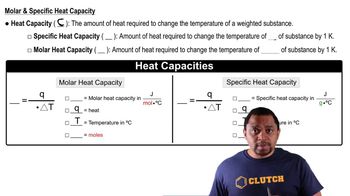
Specific Heat Capacity

Specific heat capacity is the amount of heat required to raise the temperature of one gram of a substance by one degree Celsius. For ice, this value is crucial for calculating the energy needed to increase its temperature from -11.0 °C to 0 °C before it melts. Understanding this concept allows us to quantify the energy changes associated with temperature changes in a substance.
추천 영상:

Heat of Fusion

The heat of fusion is the amount of energy required to change a substance from solid to liquid at its melting point without changing its temperature. For water, this value is 6.01 kJ/mol. This concept is essential for calculating the energy needed to melt the ice after it has reached 0 °C, as it represents the energy transition from solid ice to liquid water.
추천 영상:

Phase Changes and Temperature Ranges

Phase changes refer to the transitions between solid, liquid, and gas states of matter, which occur at specific temperature ranges. In this problem, we need to consider the heating of ice, its melting into water, and then the heating of the resulting water. Understanding the different phases and the corresponding energy requirements for each phase change is vital for accurately calculating the total energy needed for the entire process.
추천 영상:
가이드 코스
01:46
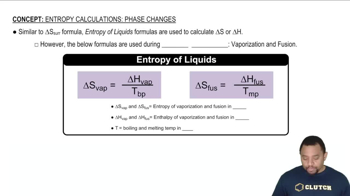
Entropy in Phase Changes