
Ch.13 - Solutions & Their Properties
McMurry - Chemistry 8th Edition
McMurry8th EditionChemistryISBN: 9781292336145당신이 사용하는 게 아니라요?교과서 변경
13장, 문제 88

When 1 mL of toluene is added to 100 mL of benzene (bp 80.1 °C), the boiling point of the benzene solution rises, but when 1 mL of benzene is added to 100 mL of toluene (bp 110.6 °C), the boiling point of the toluene solution falls. Explain.

검증된 단계별 안내
1
Understand the concept of boiling point elevation and depression, which is a colligative property. This means it depends on the number of solute particles in a solvent, not the type of particles.
Recognize that adding a non-volatile solute to a solvent generally raises the boiling point of the solvent due to the solute particles interfering with the evaporation process of the solvent.
Note that when toluene is added to benzene, the boiling point of benzene increases slightly. This is because toluene, having a higher boiling point than benzene, acts as a non-volatile solute in the benzene solution.
Consider the reverse scenario where benzene is added to toluene. Since benzene has a lower boiling point than toluene, it can be considered more volatile relative to toluene in this mixture.
Understand that the addition of a more volatile solvent (benzene) to a less volatile solvent (toluene) can lower the boiling point of the resulting solution, as the more volatile solvent increases the rate of evaporation, thus reducing the boiling point.

비슷한 문제에 대한 검증된 영상 답변:

이 영상 해법은 위 문제에 도움이 된다고 튜터들이 추천한 것입니다.
영상 길이:
3m

주요 개념

질문에 올바르게 답하기 위해 반드시 이해해야 하는 핵심 개념들은 다음과 같습니다.

Boiling Point Elevation

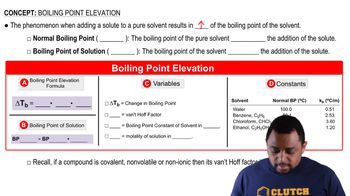
Boiling point elevation is a colligative property that describes how the boiling point of a solvent increases when a non-volatile solute is added. This phenomenon occurs because the presence of solute particles disrupts the solvent's ability to evaporate, requiring a higher temperature to reach the boiling point. In the case of toluene and benzene, adding toluene to benzene raises the boiling point due to this effect.
추천 영상:
가이드 코스
03:05
Boiling Point Elevation

Boiling Point Depression

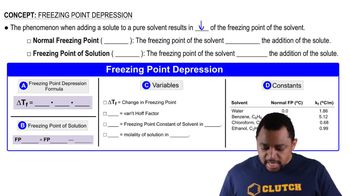
Boiling point depression is another colligative property, which occurs when the boiling point of a solvent decreases upon the addition of a solute. This can happen if the solute has a lower boiling point than the solvent, leading to a reduction in the overall vapor pressure of the solution. When benzene is added to toluene, the boiling point of the resulting solution decreases because benzene's lower boiling point influences the overall vapor pressure.
추천 영상:
가이드 코스
01:59
Freezing Point Depression

Vapor Pressure and Intermolecular Forces

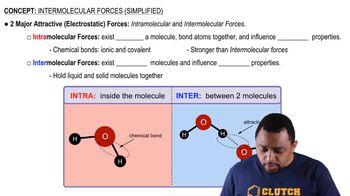
Vapor pressure is the pressure exerted by a vapor in equilibrium with its liquid or solid phase. The intermolecular forces between molecules in a solution affect the vapor pressure; stronger interactions lead to lower vapor pressures. In the case of toluene and benzene, the differences in their intermolecular forces can explain why the addition of one to the other results in different boiling point behaviors, as the solute can either enhance or diminish the vapor pressure of the solvent.
추천 영상:
가이드 코스
01:59
Intermolecular vs Intramolecular Forces