

Ch.14 - Chemical Kinetics
McMurry - Chemistry 8th Edition
McMurry8th EditionChemistryISBN: 9781292336145당신이 사용하는 게 아니라요?교과서 변경
14장, 문제 56a

Ammonia is manufactured in large amounts by the reaction
N2(g) + 3 H2(g) → 2 NH3(g)
(a) How is the rate of consumption of H2 related to the rate of consumption of N2?

검증된 단계별 안내
1
Step 1: Understand the reaction. The balanced chemical equation given is N2(g) + 3 H2(g) → 2 NH3(g). This tells us that one molecule of nitrogen reacts with three molecules of hydrogen to form two molecules of ammonia.
Step 2: Understand the concept of reaction rate. The rate of a reaction is the speed at which reactants are consumed or products are formed. It is usually expressed in terms of change in concentration of a reactant or product per unit time.
Step 3: Relate the rate of consumption of reactants. The stoichiometry of the reaction tells us that for every one molecule of N2 that reacts, three molecules of H2 are consumed. Therefore, the rate of consumption of H2 is three times the rate of consumption of N2.
Step 4: Express the relationship mathematically. If we denote the rate of consumption of N2 as -d[N2]/dt and the rate of consumption of H2 as -d[H2]/dt, then according to the stoichiometry of the reaction, -d[H2]/dt = 3(-d[N2]/dt).
Step 5: Interpret the result. This means that for every unit of time, the amount of H2 consumed is three times the amount of N2 consumed.

비슷한 문제에 대한 검증된 영상 답변:

이 영상 해법은 위 문제에 도움이 된다고 튜터들이 추천한 것입니다.
영상 길이:
4m

주요 개념

질문에 올바르게 답하기 위해 반드시 이해해야 하는 핵심 개념들은 다음과 같습니다.

Stoichiometry

Stoichiometry is the branch of chemistry that deals with the quantitative relationships between the reactants and products in a chemical reaction. In the given reaction, the coefficients indicate that one mole of nitrogen (N₂) reacts with three moles of hydrogen (H₂) to produce two moles of ammonia (NH₃). This relationship allows us to determine how the consumption rates of the reactants are related.
추천 영상:
가이드 코스
01:16
Stoichiometry Concept

Reaction Rates

The rate of a chemical reaction refers to the speed at which reactants are converted into products. It can be expressed in terms of the change in concentration of a reactant or product over time. In this case, understanding how the rate of consumption of H₂ relates to N₂ involves applying the stoichiometric coefficients to express their rates in a proportional manner.
추천 영상:
가이드 코스
02:03
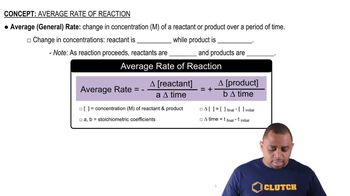
Average Rate of Reaction

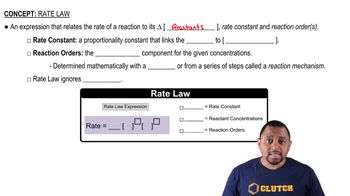
Rate Law

The rate law is an equation that relates the rate of a reaction to the concentration of its reactants. While the question focuses on stoichiometric relationships, knowing that the rate of consumption of H₂ is three times that of N₂ (due to the coefficients in the balanced equation) is essential for understanding how changes in concentration affect the overall reaction rate.
추천 영상:
가이드 코스
01:52
Rate Law Fundamentals