

Ch.14 - Chemical Kinetics
McMurry - Chemistry 8th Edition
McMurry8th EditionChemistryISBN: 9781292336145당신이 사용하는 게 아니라요?교과서 변경
14장, 문제 140a

The rate constant for the first-order decomposition of gaseous N2O5 to NO2 and O2 is 1.7 * 10-3 s-1 at 55 °C. (a) If 2.70 g of gaseous N2O5 is introduced into an evacuated 2.00 L container maintained at a constant temperature of 55 °C, what is the total pressure in the container after a reaction time of 13.0 minutes?

검증된 단계별 안내
1
Convert the mass of N_2O_5 to moles using its molar mass.
Use the first-order rate equation: \( [A] = [A]_0 e^{-kt} \) to find the concentration of N_2O_5 remaining after 13.0 minutes.
Calculate the change in moles of N_2O_5 decomposed and use stoichiometry to find the moles of NO_2 and O_2 produced.
Determine the total moles of gas present in the container after the reaction.
Use the ideal gas law, \( PV = nRT \), to calculate the total pressure in the container.

비슷한 문제에 대한 검증된 영상 답변:

이 영상 해법은 위 문제에 도움이 된다고 튜터들이 추천한 것입니다.
영상 길이:
11m

주요 개념

질문에 올바르게 답하기 위해 반드시 이해해야 하는 핵심 개념들은 다음과 같습니다.

First-Order Reactions

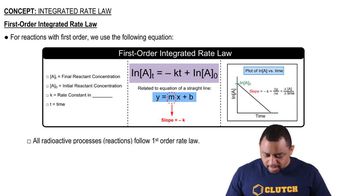
First-order reactions are chemical reactions where the rate is directly proportional to the concentration of one reactant. The rate constant (k) is a crucial parameter that defines the speed of the reaction. For first-order reactions, the integrated rate law can be used to relate concentration and time, allowing for the calculation of reactant concentration at any given time.
추천 영상:
가이드 코스
02:29
First-Order Reactions

Ideal Gas Law

The Ideal Gas Law (PV = nRT) relates the pressure (P), volume (V), number of moles (n), the ideal gas constant (R), and temperature (T) of a gas. This law is essential for calculating the total pressure in a container after a reaction, as it allows for the conversion of moles of gas produced from the reaction into pressure, given a constant volume and temperature.
추천 영상:
가이드 코스
01:15
Ideal Gas Law Formula

Stoichiometry of Gas Reactions

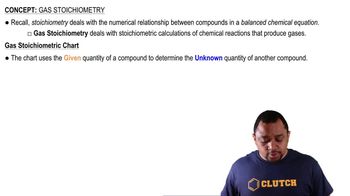
Stoichiometry involves the calculation of reactants and products in chemical reactions based on balanced equations. In the context of gas reactions, it is important to understand the molar ratios of reactants and products to determine how much gas is produced or consumed. This is particularly relevant when calculating the total pressure in a container after a reaction has occurred.
추천 영상:
가이드 코스
00:47
Gas Stoichiometry Concepts
관련 실천
교과서 질문
A 0.500 L reaction vessel equipped with a movable piston is filled completely with a 3.00% aqueous solution of hydrogen peroxide. The H2O2 decomposes to water and O2 gas in a first-order reaction that has a half-life of 10.7 h. As the reaction proceeds, the gas formed pushes the piston against a constant external atmospheric pressure of 738 mm Hg. Calculate the PV work done (in joules) after a reaction time of 4.02 h. (You may assume that the density of the solution is 1.00 g/mL and that the temperature of the system is maintained at 20 °C.)
627
views
교과서 질문
For the thermal decomposition of nitrous oxide, 2 N2O1g2S 2 N21g2 + O21g2, values of the parameters in the Arrhenius equation are A = 4.2 * 109 s-1 and Ea = 222 kJ>mol. If a stream of N2O is passed through a tube 25 mm in diameter and 20 cm long at a flow rate of 0.75 L/min at what temperature should the tube be maintained to have a partial pressure of 1.0 mm of O2 in the exit gas? Assume that the total pressure of the gas in the tube is 1.50 atm.
867
views
교과서 질문
The rate constant for the decomposition of gaseous NO2 to NO and O2 is 4.7>1M ~ s2 at 383 °C. Consider the decomposition of a sample of pure NO2 having an initial pressure of 746 mm Hg in a 5.00 L reaction vessel at 383 °C. (c) What is the mass of O2 in the vessel after a reaction time of 1.00 min?
1245
views
1
rank
교과서 질문
A 1.50 L sample of gaseous HI having a density of 0.0101 g>cm3 is heated at 410 °C. As time passes, the HI decomposes to gaseous H2 and I2. The rate law is -Δ3HI4>Δt = k3HI42, where k = 0.031>1M ~ min2 at 410 °C. (b) What is the partial pressure of H2 after a reaction time of 8.00 h?
403
views
교과서 질문

The rate constant for the first-order decomposition of gaseous N2O5 to NO2 and O2 is 1.7 * 10-3 s-1 at 55 °C. (b) Use the data in Appendix B to calculate the initial rate at which the reaction mixture absorbs heat (in J/s). You may assume that the heat of the reaction is independent of temperature.

502
views
교과서 질문

Values of Ea = 6.3 kJ/mol and A = 6.0⨉108/(M s) have been measured for the bimolecular reaction: NO(g) + F2(g) → NOF(g) + F(g) (d) Why does the reaction have such a low activation energy?

267
views