What is the half-life (in minutes) of the reaction in Problem
14.74 when the initial C4H6 concentration is 0.0200 M?
How many minutes does it take for the concentration of
C4H6 to drop from 0.0100 M to 0.0050 M?
검증된 단계별 안내
1
Identify the order of the reaction from Problem 14.74. This will determine the formula used to calculate the half-life.
For a first-order reaction, use the half-life formula: \(t_{1/2} = \frac{0.693}{k}\), where \(k\) is the rate constant.
For a second-order reaction, use the half-life formula: \(t_{1/2} = \frac{1}{k[A]_0}\), where \([A]_0\) is the initial concentration.
To find the time it takes for the concentration to drop from 0.0100 M to 0.0050 M, use the integrated rate law for the determined order of the reaction.
For a first-order reaction, use \(\ln\left(\frac{[A]_0}{[A]}
ight) = kt\). For a second-order reaction, use \(\frac{1}{[A]} - \frac{1}{[A]_0} = kt\). Solve for \(t\).
비슷한 문제에 대한 검증된 영상 답변:
이 영상 해법은 위 문제에 도움이 된다고 튜터들이 추천한 것입니다.
영상 길이:
6m
영상 재생:
0 댓글
주요 개념
질문에 올바르게 답하기 위해 반드시 이해해야 하는 핵심 개념들은 다음과 같습니다.
Half-Life
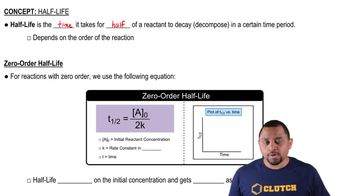
Half-life is the time required for the concentration of a reactant to decrease to half of its initial value. In chemical kinetics, it is a crucial parameter that helps in understanding the rate of a reaction. The half-life can vary depending on the order of the reaction; for first-order reactions, it remains constant, while for second-order reactions, it depends on the initial concentration.
The order of a reaction refers to the power to which the concentration of a reactant is raised in the rate law. It provides insight into how the rate of reaction is affected by the concentration of reactants. For example, a first-order reaction has a linear relationship between concentration and rate, while a second-order reaction has a quadratic relationship, influencing how half-life is calculated.
Concentration change refers to the variation in the amount of a substance in a given volume over time during a chemical reaction. Understanding how concentration decreases allows for the calculation of time intervals, such as how long it takes for a reactant's concentration to drop from one value to another. This concept is essential for determining the kinetics of a reaction and its half-life.


 검증된 단계별 안내
 02:17
02:17