
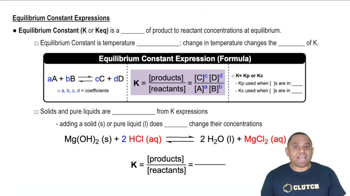
Refining petroleum involves cracking large hydrocarbon molecules into smaller, more volatile pieces. A simple example of hydrocarbon cracking is the gas-phase thermal decomposition of butane to give ethane and ethylene: (a) Write the equilibrium constant expressions for Kp and Kc.
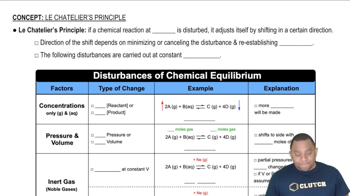
At 1000 K, Kp = 2.1 * 106 and ΔH° = - 107.7 kJ for the reaction H21g2 + Br21g2 ∆ 2 HBr1g2. (b) For the equilibrium in part (a), each of the following changes will increase the equilibrium partial pressure of HBr. Choose the change that will cause the greatest increase in the pressure of HBr, and explain your choice. (ii) Adding 0.10 mol of Br2
검증된 단계별 안내
비슷한 문제에 대한 검증된 영상 답변:
주요 개념
Le Chatelier's Principle
Equilibrium Constant (Kp)
Reaction Quotient (Q)
The F-F bond in F2 is relatively weak because the lone pairs of electrons on one F atom repel the lone pairs on the other F atom; Kp = 7.83 at 1500 K for the reaction F2(g) ⇌ 2 F(g). (a) If the equilibrium partial pressure of F2 molecules at 1500 K is 0.200 atm, what is the equilibrium partial pressure of F atoms in atm?
Refining petroleum involves cracking large hydrocarbon molecules into smaller, more volatile pieces. A simple example of hydrocarbon cracking is the gas-phase thermal decomposition of butane to give ethane and ethylene: (c) A sample of butane having a pressure of 50 atm is heated at 500 °C in a closed container at constant volume. When equilibrium is reached, what percentage of the butane has been converted to ethane and ethylene? What is the total pressure at equilibrium?
