Ch.15 - Chemical Equilibrium
McMurry - Chemistry 8th Edition
McMurry8th EditionChemistryISBN: 9781292336145당신이 사용하는 게 아니라요?교과서 변경
15장, 문제 128

The following reaction is important in gold mining: 4 Au1s2 + 8 CN-1aq2 + O21g2 + 2 H2O1l2 ∆ 4 Au1CN22-1aq2 + 4 OH-1aq2For a reaction mixture at equilibrium, in which direction would the reaction go to reestablish equilibrium after each of the following changes? (a) Adding gold

검증된 단계별 안내
1
insert step 1> Identify the reaction and its components. The given reaction is: 4 Au_{(s)} + 8 CN^-_{(aq)} + O_2_{(g)} + 2 H_2O_{(l)} \(\rightarrow\) 4 Au(CN)_2^-_{(aq)} + 4 OH^-_{(aq)}.
insert step 2> Recognize that the reaction is at equilibrium, meaning the rate of the forward reaction equals the rate of the reverse reaction.
insert step 3> Apply Le Chatelier's Principle, which states that if a dynamic equilibrium is disturbed by changing the conditions, the position of equilibrium shifts to counteract the change.
insert step 4> Consider the effect of adding gold (Au) to the system. Since gold is a reactant, adding more gold will shift the equilibrium to the right to produce more products, in order to reduce the concentration of gold.
insert step 5> Conclude that the addition of gold will cause the reaction to shift towards the formation of more Au(CN)_2^- and OH^- ions, thus moving the equilibrium to the right.

비슷한 문제에 대한 검증된 영상 답변:

이 영상 해법은 위 문제에 도움이 된다고 튜터들이 추천한 것입니다.
영상 길이:
1m

주요 개념

질문에 올바르게 답하기 위해 반드시 이해해야 하는 핵심 개념들은 다음과 같습니다.

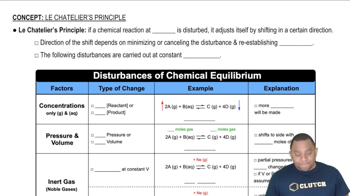
Le Chatelier's Principle

Le Chatelier's Principle states that if a dynamic equilibrium is disturbed by changing the conditions, the position of equilibrium shifts to counteract the change. This principle helps predict how a system at equilibrium will respond to changes in concentration, pressure, or temperature, allowing us to determine the direction in which the reaction will shift.
추천 영상:
가이드 코스
07:32
Le Chatelier's Principle

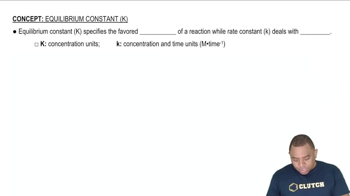
Equilibrium Constant (K)

The equilibrium constant (K) is a numerical value that expresses the ratio of the concentrations of products to reactants at equilibrium for a given reaction at a specific temperature. It provides insight into the extent of the reaction and helps in understanding how changes in concentration affect the position of equilibrium.
추천 영상:
가이드 코스
01:14
Equilibrium Constant K

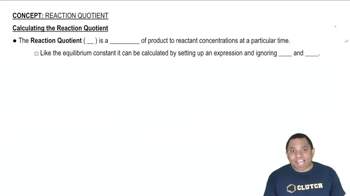
Reaction Quotient (Q)

The reaction quotient (Q) is a measure of the relative concentrations of products and reactants at any point in a reaction, not just at equilibrium. By comparing Q to K, one can determine the direction in which the reaction will shift to reach equilibrium: if Q < K, the reaction shifts right (toward products), and if Q > K, it shifts left (toward reactants).
추천 영상:
가이드 코스
00:49
Reaction Quotient Q