Ch.15 - Chemical Equilibrium
McMurry - Chemistry 8th Edition
McMurry8th EditionChemistryISBN: 9781292336145당신이 사용하는 게 아니라요?교과서 변경
15장, 문제 115

The reaction of fumarate with water to form L-malate is catalyzed by the enzyme fumarase; Kc = 3.3 at 37°C. When a reaction mixture with [fumarate] = 1.56 * 10-3 M and [l -malate] = 2.27 * 10-3 M comes to equilibrium in the presence of fumarase at 37 °C, what are the equilibrium concentrations of fumarate and L-malate? (Water can be omit- ted from the equilibrium equation because its concentration in dilute solutions is essentially the same as that in pure water.)

검증된 단계별 안내
1
Step 1: Write down the equilibrium expression for the reaction. Since water is not included in the equilibrium expression, the equilibrium constant Kc for the reaction is given by [L-malate]/[fumarate].
Step 2: Set up the ICE (Initial, Change, Equilibrium) table. Initially, [fumarate] = 1.56 * 10^-3 M and [L-malate] = 2.27 * 10^-3 M. Let x be the change in concentration of fumarate and L-malate as the reaction proceeds to equilibrium.
Step 3: Write the equilibrium concentrations in terms of x. The equilibrium concentration of fumarate will be (1.56 * 10^-3 - x) M and the equilibrium concentration of L-malate will be (2.27 * 10^-3 + x) M.
Step 4: Substitute the equilibrium concentrations into the equilibrium expression and set it equal to the given Kc value of 3.3. Solve the resulting equation for x.
Step 5: Substitute the value of x back into the expressions for the equilibrium concentrations of fumarate and L-malate to find their values at equilibrium.

비슷한 문제에 대한 검증된 영상 답변:

이 영상 해법은 위 문제에 도움이 된다고 튜터들이 추천한 것입니다.
영상 길이:
4m

주요 개념

질문에 올바르게 답하기 위해 반드시 이해해야 하는 핵심 개념들은 다음과 같습니다.

Equilibrium Constant (Kc)

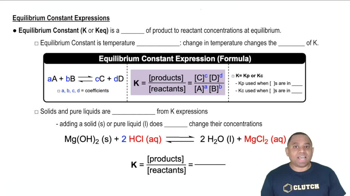
The equilibrium constant (Kc) is a numerical value that expresses the ratio of the concentrations of products to reactants at equilibrium for a given reaction at a specific temperature. In this case, Kc = 3.3 indicates that at equilibrium, the concentration of L-malate is 3.3 times greater than that of fumarate. Understanding Kc is essential for calculating the equilibrium concentrations of reactants and products.
추천 영상:
가이드 코스
03:20
Equilibrium Constant Expressions

Le Chatelier's Principle

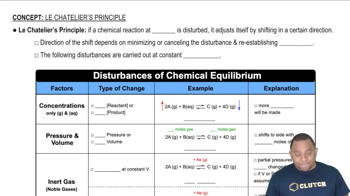
Le Chatelier's Principle states that if a dynamic equilibrium is disturbed by changing the conditions, the system will adjust to counteract the change and restore a new equilibrium. This principle helps predict how changes in concentration, temperature, or pressure will affect the position of equilibrium, which is crucial for understanding how the concentrations of fumarate and L-malate will shift in response to their initial concentrations.
추천 영상:
가이드 코스
07:32
Le Chatelier's Principle

Reaction Quotient (Q)

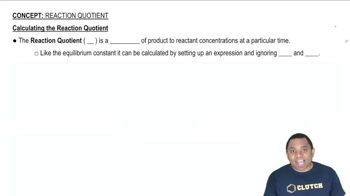
The reaction quotient (Q) is a measure of the relative concentrations of products and reactants at any point in time during a reaction. It is calculated using the same formula as Kc but with the current concentrations. By comparing Q to Kc, one can determine the direction in which the reaction will proceed to reach equilibrium, which is vital for solving the problem of finding the equilibrium concentrations of fumarate and L-malate.
추천 영상:
가이드 코스
00:49
Reaction Quotient Q