
Ch.15 - Chemical Equilibrium
McMurry - Chemistry 8th Edition
McMurry8th EditionChemistryISBN: 9781292336145당신이 사용하는 게 아니라요?교과서 변경
15장, 문제 137

Which of the following relative values of kf and kr results in an equilibrium mixture that contains large amounts of reactants and small amounts of products? (a) kf 7 kr (b) kf = kr (c) kf 6 kr

검증된 단계별 안내
1
Identify the meaning of kf and kr: kf represents the forward reaction rate constant, and kr represents the reverse reaction rate constant.
Understand the relationship between kf, kr, and the position of equilibrium: If kf > kr, the reaction favors the formation of products. If kf < kr, the reaction favors the formation of reactants.
Analyze the given options to determine which scenario leads to a reaction favoring the formation of reactants: (a) kf > kr, (b) kf = kr, (c) kf < kr.
Compare the options to the desired condition of having large amounts of reactants and small amounts of products, which indicates that the equilibrium should lie towards the reactants.
Conclude that the correct option where kf < kr (option c) will result in an equilibrium mixture containing large amounts of reactants and small amounts of products.

비슷한 문제에 대한 검증된 영상 답변:

이 영상 해법은 위 문제에 도움이 된다고 튜터들이 추천한 것입니다.
영상 길이:
1m

주요 개념

질문에 올바르게 답하기 위해 반드시 이해해야 하는 핵심 개념들은 다음과 같습니다.

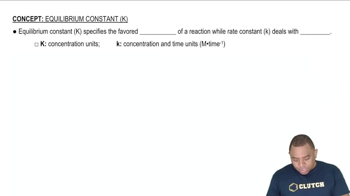
Equilibrium Constant (K)

The equilibrium constant (K) is a numerical value that expresses the ratio of the concentrations of products to reactants at equilibrium for a given reaction at a specific temperature. It is defined as K = [products]^[coefficients] / [reactants]^[coefficients]. A large K value indicates that products are favored at equilibrium, while a small K value suggests that reactants are favored.
추천 영상:
가이드 코스
01:14
Equilibrium Constant K

Forward and Reverse Rate Constants (kf and kr)

The forward rate constant (kf) and the reverse rate constant (kr) are parameters that describe the speed of the forward and reverse reactions, respectively. The relationship between these constants determines the position of equilibrium. If kf is much smaller than kr, the reaction favors the formation of reactants, leading to a higher concentration of reactants at equilibrium.
추천 영상:
가이드 코스
00:45
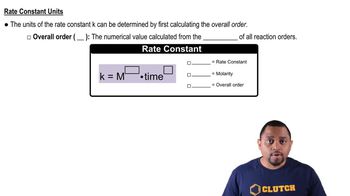
Rate Constant Units

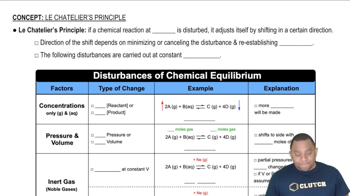
Le Chatelier's Principle

Le Chatelier's Principle states that if a system at equilibrium is subjected to a change in concentration, temperature, or pressure, the system will adjust to counteract that change and restore a new equilibrium. This principle helps predict how changes in conditions will affect the concentrations of reactants and products, providing insight into the behavior of the equilibrium mixture.
추천 영상:
가이드 코스
07:32
Le Chatelier's Principle