Ch.16 - Aqueous Equilibria: Acids & Bases
McMurry - Chemistry 8th Edition
McMurry8th EditionChemistryISBN: 9781292336145당신이 사용하는 게 아니라요?교과서 변경
16장, 문제 158b

A 1.000 L sample of HF gas at 20.0 °C and 0.601 atm pressure was dissolved in enough water to make 50.0 mL of hydrofluoric acid. (b) To what volume must you dilute the solution to triple the percent dissociation?

검증된 단계별 안내
1
Determine the initial moles of HF gas using the ideal gas law: PV = nRT, where P is pressure, V is volume, n is moles, R is the ideal gas constant, and T is temperature in Kelvin.
Calculate the initial concentration of HF in the 50.0 mL solution by dividing the moles of HF by the volume of the solution in liters.
Understand that the percent dissociation of HF is related to its concentration and the equilibrium constant (Ka). Use the expression for percent dissociation: (dissociated concentration / initial concentration) * 100%.
To triple the percent dissociation, set up an equation where the new percent dissociation is three times the initial percent dissociation. Use the relationship between concentration and percent dissociation to express this condition.
Solve for the new volume of the solution that will achieve the desired percent dissociation by considering the dilution effect on concentration and using the equation C1V1 = C2V2, where C1 and V1 are the initial concentration and volume, and C2 and V2 are the final concentration and volume.

비슷한 문제에 대한 검증된 영상 답변:

이 영상 해법은 위 문제에 도움이 된다고 튜터들이 추천한 것입니다.
영상 길이:
11m

주요 개념

질문에 올바르게 답하기 위해 반드시 이해해야 하는 핵심 개념들은 다음과 같습니다.

Percent Dissociation

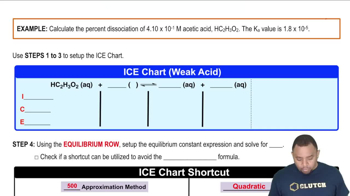
Percent dissociation refers to the fraction of a weak acid or base that ionizes in solution, expressed as a percentage. For example, if 1 mole of HF dissociates into 0.3 moles of H+ and F-, the percent dissociation would be (0.3/1) * 100 = 30%. Understanding this concept is crucial for determining how dilution affects the ionization of the acid.
추천 영상:
가이드 코스
04:52
Percent Dissociation Example

Dilution and Concentration

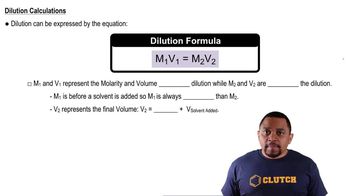
Dilution is the process of reducing the concentration of a solute in a solution, typically by adding more solvent. The relationship between the initial and final concentrations and volumes is given by the equation C1V1 = C2V2, where C is concentration and V is volume. This principle is essential for calculating the new volume required to achieve a desired percent dissociation.
추천 영상:
가이드 코스
00:58
Dilution Equation

Equilibrium Constant (Ka)

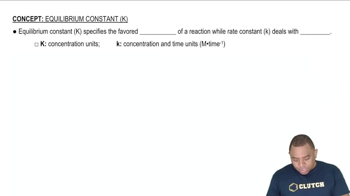
The equilibrium constant (Ka) for a weak acid quantifies its strength and the extent of dissociation in solution. It is defined as the ratio of the concentration of the products to the concentration of the reactants at equilibrium. For HF, the Ka value helps predict how changes in concentration, such as dilution, will affect the degree of ionization and thus the percent dissociation.
추천 영상:
가이드 코스
01:14
Equilibrium Constant K