Ch.16 - Aqueous Equilibria: Acids & Bases
McMurry - Chemistry 8th Edition
McMurry8th EditionChemistryISBN: 9781292336145당신이 사용하는 게 아니라요?교과서 변경
16장, 문제 99

A typical aspirin tablet contains 324 mg of aspirin (acetylsalicylic acid, C9H8O4), a monoprotic acid having Ka = 3.0 * 10-4. If you dissolve two aspirin tablets in a 300 mL glass of water, what is the pH of the solution and the percent dissociation? Chemical structure of acetylsalicylic acid highlighting the acidic hydrogen.

검증된 단계별 안내
1
Calculate the total mass of aspirin in two tablets: 2 * 324 mg.
Convert the mass of aspirin to grams and then to moles using the molar mass of acetylsalicylic acid (C9H8O4).
Determine the concentration of aspirin in the solution by dividing the number of moles by the volume of the solution in liters (300 mL).
Set up the expression for the dissociation of acetylsalicylic acid (HA) in water and use the given Ka value to write the equilibrium expression: Ka = [H+][A-]/[HA].
Solve for the concentration of H+ ions ([H+]) using the quadratic formula or approximation method, then calculate the pH of the solution using the formula pH = -log[H+].

비슷한 문제에 대한 검증된 영상 답변:

이 영상 해법은 위 문제에 도움이 된다고 튜터들이 추천한 것입니다.
영상 길이:
9m

주요 개념

질문에 올바르게 답하기 위해 반드시 이해해야 하는 핵심 개념들은 다음과 같습니다.

Monoprotic Acids

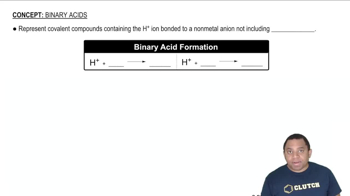
A monoprotic acid is an acid that can donate only one proton (H+) per molecule during dissociation. In the case of acetylsalicylic acid (aspirin), it has one acidic hydrogen that can dissociate in solution, contributing to the acidity of the solution. Understanding the behavior of monoprotic acids is essential for calculating pH and percent dissociation.
추천 영상:

Acid Dissociation Constant (Ka)

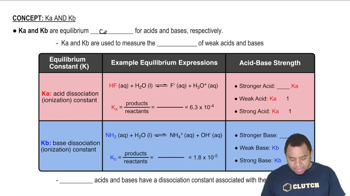
The acid dissociation constant (Ka) quantifies the strength of an acid in solution. It is defined as the equilibrium constant for the dissociation of the acid into its conjugate base and a proton. For aspirin, with a Ka of 3.0 x 10^-4, this value indicates that it is a weak acid, and it helps in calculating the concentration of hydrogen ions in solution, which is crucial for determining pH.
추천 영상:
가이드 코스
03:50
Characteristics of Ka and Kb

Percent Dissociation

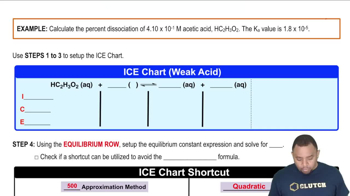
Percent dissociation is a measure of the extent to which an acid dissociates in solution, expressed as a percentage of the initial concentration that has dissociated into ions. It is calculated using the formula: (amount dissociated / initial concentration) x 100%. This concept is important for understanding the strength of the acid and its effect on the pH of the solution when aspirin is dissolved in water.
추천 영상:
가이드 코스
04:52
Percent Dissociation Example