

Ch.17 - Applications of Aqueous Equilibria
McMurry - Chemistry 8th Edition
McMurry8th EditionChemistryISBN: 9781292336145당신이 사용하는 게 아니라요?교과서 변경
17장, 문제 149

A 1.000 L sample of HCl gas at 25°C and 732.0 mm Hg was absorbed completely in an aqueous solution that contained 6.954 g of Na2CO3 and 250.0 g of water. (a) What is the pH of the solution?

검증된 단계별 안내
1
Step 1: First, we need to calculate the number of moles of HCl gas. We can use the ideal gas law equation, PV = nRT, where P is the pressure, V is the volume, n is the number of moles, R is the ideal gas constant, and T is the temperature in Kelvin. Convert the pressure from mm Hg to atm and the temperature from Celsius to Kelvin before substituting the values into the equation.
Step 2: Next, we need to calculate the number of moles of Na2CO3. We can do this by using the molar mass of Na2CO3, which is approximately 105.99 g/mol. Divide the mass of Na2CO3 by its molar mass to get the number of moles.
Step 3: Now, we need to write the balanced chemical equation for the reaction between HCl and Na2CO3. The equation is: 2HCl + Na2CO3 -> 2NaCl + H2O + CO2. From the balanced equation, we can see that 2 moles of HCl react with 1 mole of Na2CO3.
Step 4: Determine the limiting reactant. If the number of moles of HCl is more than twice the number of moles of Na2CO3, then Na2CO3 is the limiting reactant. If not, HCl is the limiting reactant. The limiting reactant will determine the amount of HCl that remains unreacted and contributes to the acidity of the solution.
Step 5: Finally, calculate the pH of the solution. If HCl is the limiting reactant, all of it will react and the solution will be neutral, with a pH of 7. If Na2CO3 is the limiting reactant, some HCl will remain unreacted. The concentration of HCl can be calculated by dividing the remaining moles of HCl by the total volume of the solution. The pH can then be calculated using the formula pH = -log[H+], where [H+] is the concentration of H+ ions, which is equal to the concentration of HCl in the solution.

비슷한 문제에 대한 검증된 영상 답변:

이 영상 해법은 위 문제에 도움이 된다고 튜터들이 추천한 것입니다.
영상 길이:
13m

주요 개념

질문에 올바르게 답하기 위해 반드시 이해해야 하는 핵심 개념들은 다음과 같습니다.

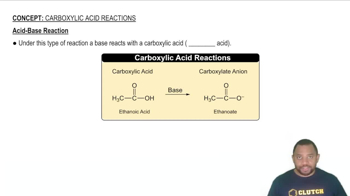
Acid-Base Reactions

Acid-base reactions involve the transfer of protons (H+) between reactants. In this case, HCl, a strong acid, will dissociate completely in water, releasing H+ ions. The reaction with Na2CO3, a weak base, will produce bicarbonate ions and affect the pH of the solution, making it essential to understand how these species interact.
추천 영상:
가이드 코스
01:09
Acid-Base Reaction

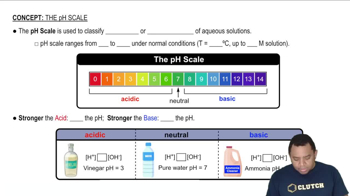
pH Scale

The pH scale measures the acidity or basicity of a solution, ranging from 0 (very acidic) to 14 (very basic), with 7 being neutral. The pH is calculated as the negative logarithm of the hydrogen ion concentration. Understanding how to calculate pH from the concentration of H+ ions is crucial for determining the acidity of the resulting solution after the reaction.
추천 영상:

Stoichiometry

Stoichiometry involves the calculation of reactants and products in chemical reactions based on balanced equations. In this scenario, determining the amount of HCl that reacts with Na2CO3 requires stoichiometric relationships to find the moles of each substance involved, which is necessary for calculating the resulting pH of the solution.
추천 영상:
가이드 코스
01:16
Stoichiometry Concept
관련 실천