
Ch.17 - Applications of Aqueous Equilibria
McMurry - Chemistry 8th Edition
McMurry8th EditionChemistryISBN: 9781292336145당신이 사용하는 게 아니라요?교과서 변경
17장, 문제 95b,c

Consider the titration of 50.0 mL of a 0.100 M solution of the protonated form of the amino acid alanine (H2A+: Ka1 = 4.6 × 10⁻³, Ka2 = 2.0 × 10⁻¹⁰) with 0.100 M NaOH. Calculate the pH after the addition of each of the following volumes of base. (b) 25.0 mL (c) 50.0 mL

검증된 단계별 안내
1
Determine the initial moles of H2A+ in the solution by multiplying the volume (50.0 mL) by the concentration (0.100 M). Convert the volume to liters before multiplying.
Calculate the moles of NaOH added by multiplying the volume of NaOH added (25.0 mL for part b and 50.0 mL for part c) by its concentration (0.100 M). Convert the volume to liters before multiplying.
For part (b), compare the moles of NaOH added to the initial moles of H2A+. Since 25.0 mL of NaOH is added, it is half the equivalence point, and the solution is a buffer. Use the Henderson-Hasselbalch equation to find the pH, considering the first dissociation (Ka1).
For part (c), since 50.0 mL of NaOH is added, it reaches the first equivalence point where all H2A+ is converted to HA. Calculate the pH by considering the hydrolysis of HA using the second dissociation constant (Ka2) and the concentration of HA at this point.
Use the appropriate equilibrium expressions and assumptions to solve for the pH in each case, ensuring to check if any simplifications can be made based on the relative magnitudes of Ka1 and Ka2.

비슷한 문제에 대한 검증된 영상 답변:

이 영상 해법은 위 문제에 도움이 된다고 튜터들이 추천한 것입니다.
영상 길이:
23m

주요 개념

질문에 올바르게 답하기 위해 반드시 이해해야 하는 핵심 개념들은 다음과 같습니다.

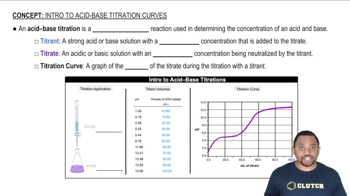
Titration

Titration is a quantitative analytical technique used to determine the concentration of a solute in a solution. It involves the gradual addition of a titrant (a solution of known concentration) to a sample until a reaction is complete, indicated by a color change or a pH change. In this case, the titration of alanine with NaOH will help determine the pH at specific volumes of base added.
추천 영상:
가이드 코스
03:04
Acid-Base Titration

Acid-Base Equilibria

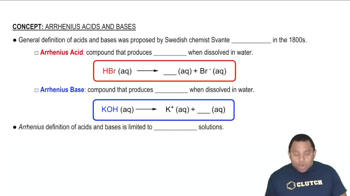
Acid-base equilibria involve the balance between proton donors (acids) and proton acceptors (bases) in a solution. The dissociation constants (Ka) of the amino acid alanine indicate its ability to donate protons at different pH levels. Understanding these equilibria is crucial for calculating the pH during titration, especially when determining the point at which the amino acid transitions from its protonated to deprotonated forms.
추천 영상:
가이드 코스
02:00
Arrhenius Acids and Bases

Henderson-Hasselbalch Equation

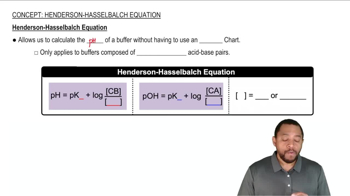
The Henderson-Hasselbalch equation is a mathematical formula used to calculate the pH of a buffer solution based on the concentration of the acid and its conjugate base. It is expressed as pH = pKa + log([A-]/[HA]). This equation is particularly useful in titration problems involving weak acids and their conjugate bases, such as alanine, as it allows for the determination of pH at various stages of the titration process.
추천 영상:
가이드 코스
02:40
Henderson-Hasselbalch Equation