Ch.17 - Applications of Aqueous Equilibria
McMurry - Chemistry 8th Edition
McMurry8th EditionChemistryISBN: 9781292336145당신이 사용하는 게 아니라요?교과서 변경
17장, 문제 82

Make a rough plot of pH versus milliliters of acid added for the titration of 50.0 mL of 1.0 M NaOH with 1.0 M HCl. Indicate the pH at the following points, and tell how many milliliters of acid are required to reach the equivalence point. (a) At the start of the titration (b) At the equivalence point (c) After the addition of a large excess of acid

검증된 단계별 안내
1
insert step 1: Understand the titration process. This is a strong base (NaOH) being titrated with a strong acid (HCl). The reaction is NaOH + HCl -> NaCl + H2O.
insert step 2: Calculate the initial pH. At the start, you have 50.0 mL of 1.0 M NaOH. Since NaOH is a strong base, it completely dissociates, and the pH can be calculated using pH = 14 - pOH, where pOH = -log[OH^-].
insert step 3: Determine the equivalence point. At the equivalence point, moles of NaOH = moles of HCl. Since both solutions are 1.0 M, the volume of HCl needed is equal to the volume of NaOH, which is 50.0 mL. At this point, the solution is neutral, and the pH is 7.
insert step 4: Calculate the pH after adding a large excess of acid. After the equivalence point, the pH is determined by the excess HCl. Calculate the concentration of H^+ ions from the excess HCl and use pH = -log[H^+].
insert step 5: Sketch the titration curve. Start with a high pH, decrease sharply at the equivalence point, and level off at a low pH after adding excess acid.

비슷한 문제에 대한 검증된 영상 답변:

이 영상 해법은 위 문제에 도움이 된다고 튜터들이 추천한 것입니다.
영상 길이:
1s

주요 개념

질문에 올바르게 답하기 위해 반드시 이해해야 하는 핵심 개념들은 다음과 같습니다.

Titration

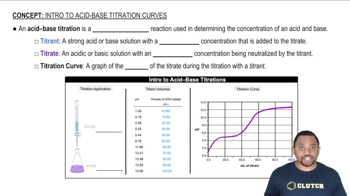
Titration is a quantitative analytical technique used to determine the concentration of a solute in a solution. It involves the gradual addition of a titrant (in this case, HCl) to a solution of analyte (NaOH) until the reaction reaches its equivalence point, where the amount of titrant added is stoichiometrically equivalent to the amount of analyte present.
추천 영상:
가이드 코스
03:04
Acid-Base Titration

pH Scale

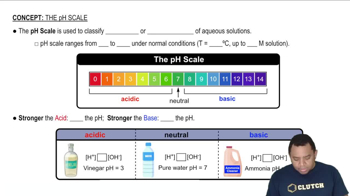
The pH scale measures the acidity or basicity of a solution, ranging from 0 to 14. A pH of 7 is neutral, below 7 indicates acidity, and above 7 indicates basicity. In the context of titration, the pH changes significantly as the titrant is added, especially around the equivalence point, where the solution transitions from basic to acidic.
추천 영상:

Equivalence Point

The equivalence point in a titration is the stage at which the amount of titrant added is exactly enough to completely neutralize the analyte. For the titration of NaOH with HCl, the equivalence point occurs when the moles of HCl added equal the moles of NaOH present. This point is crucial for determining the endpoint of the titration and is typically indicated by a sharp change in pH.
추천 영상:
가이드 코스
01:07
At the Equivalence Point