Ch.17 - Applications of Aqueous Equilibria
McMurry - Chemistry 8th Edition
McMurry8th EditionChemistryISBN: 9781292336145당신이 사용하는 게 아니라요?교과서 변경
17장, 문제 51

Phenol (C6H5OH, Ka = 1.3 x 10^-10) is a weak acid used in mouthwashes, and pyridine (C5H5N, Kb = 1.8 x 10^-9) is a weak base used as a solvent. Calculate the value of Kn for the neutralization of phenol by pyridine. Does the neutralization reaction proceed very far toward completion?

검증된 단계별 안내
1
Step 1: Understand that the neutralization reaction between an acid and a base forms a salt and water. In this case, phenol (C6H5OH) reacts with pyridine (C5H5N) to form a salt and water. The reaction can be written as: C6H5OH + C5H5N -> C6H5OC5H5N + H2O
Step 2: Recall that the equilibrium constant for the neutralization reaction, Kn, is related to the acid dissociation constant, Ka, and the base dissociation constant, Kb, by the equation: Kn = Ka * Kb. This is because the neutralization reaction is the reverse of the acid and base dissociation reactions.
Step 3: Substitute the given values of Ka and Kb into the equation from step 2 to calculate Kn. Ka = 1.3 x 10^-10 and Kb = 1.8 x 10^-9.
Step 4: To determine whether the neutralization reaction proceeds very far toward completion, compare the value of Kn to 1. If Kn >> 1, the reaction proceeds almost to completion. If Kn << 1, the reaction does not proceed very far.
Step 5: If the value of Kn is very small (much less than 1), it indicates that the reaction does not proceed very far towards completion. This is because the equilibrium lies to the left, favoring the reactants (phenol and pyridine) over the products (the salt and water).

비슷한 문제에 대한 검증된 영상 답변:

이 영상 해법은 위 문제에 도움이 된다고 튜터들이 추천한 것입니다.
영상 길이:
2m

주요 개념

질문에 올바르게 답하기 위해 반드시 이해해야 하는 핵심 개념들은 다음과 같습니다.

Acid-Base Equilibrium

Acid-base equilibrium involves the balance between acids and bases in a solution, characterized by their dissociation constants (Ka for acids and Kb for bases). In this context, phenol acts as a weak acid, partially dissociating in solution, while pyridine acts as a weak base, accepting protons. Understanding these equilibria is crucial for calculating the overall reaction constants and predicting the direction of the reaction.
추천 영상:
가이드 코스
6:47
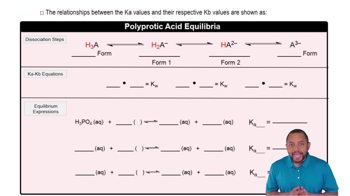
Triprotic Acid Equilibrium

Neutralization Reaction

A neutralization reaction occurs when an acid reacts with a base to form water and a salt. The strength of the acid and base involved determines the extent of the reaction. In this case, the neutralization of phenol by pyridine can be analyzed using the relationship between their dissociation constants to find the equilibrium constant (Kn) for the reaction, which indicates how far the reaction will proceed.
추천 영상:
가이드 코스
05:56
Lewis Dot Structures: Neutral Compounds

Equilibrium Constant (Kn)

The equilibrium constant (Kn) for a neutralization reaction is derived from the acid dissociation constant (Ka) of the acid and the base dissociation constant (Kb) of the base. It is calculated using the formula Kn = Kw / (Ka * Kb), where Kw is the ion product of water. A small value of Kn suggests that the reaction does not proceed far toward completion, indicating that the reactants remain significantly present in the solution.
추천 영상:
가이드 코스
01:14
Equilibrium Constant K