Ch.17 - Applications of Aqueous Equilibria
McMurry - Chemistry 8th Edition
McMurry8th EditionChemistryISBN: 9781292336145당신이 사용하는 게 아니라요?교과서 변경
17장, 문제 11

The pH titration curve applies to the titration of 40.0 mL of a 0.100 M solution of an acid with 0.100 M NaOH. What are the approximate pKa values for this acid? Titration curve showing pH change versus volume of NaOH added for a diprotic acid.
(a) pKa1 = 5, pKa2 = 10 (b) pKa1 = 7, pKa2 = 11 (c) pKa1 = 5, pKa2 = 10, pKa3 = 13 (d) pKa1 = 5, pKa2 = 7, pKa3 = 10

검증된 단계별 안내
1
Identify the regions of the titration curve where the pH changes rapidly. These are the equivalence points.
Determine the volume of NaOH added at each equivalence point by looking at the steepest parts of the curve.
Find the midpoint of each buffer region, which is halfway between the equivalence points. The pH at these midpoints corresponds to the pKa values.
Estimate the pH values at these midpoints from the graph.
Compare the estimated pKa values with the given options to determine the correct answer.

비슷한 문제에 대한 검증된 영상 답변:

이 영상 해법은 위 문제에 도움이 된다고 튜터들이 추천한 것입니다.
영상 길이:
2m

주요 개념

질문에 올바르게 답하기 위해 반드시 이해해야 하는 핵심 개념들은 다음과 같습니다.

Titration and pH Curves

Titration is a technique used to determine the concentration of an unknown solution by reacting it with a solution of known concentration. The pH curve represents the change in pH as a titrant is added, showing distinct regions where the pH changes rapidly, indicating the presence of equivalence points. These points correspond to the complete neutralization of the acid by the base, which is crucial for determining the pKa values of the acid.
추천 영상:
가이드 코스
01:35
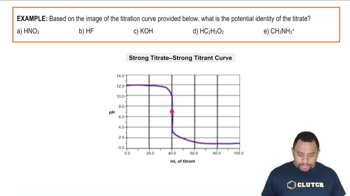
Acid-Base Titration Curve Example

pKa and Acid-Base Equilibria

The pKa value is a measure of the strength of an acid, defined as the negative logarithm of its acid dissociation constant (Ka). It indicates the pH at which half of the acid is dissociated, providing insight into the acid's ability to donate protons. In a titration curve, the pKa values can be identified at the inflection points where the pH changes most dramatically, corresponding to the acid's dissociation stages.
추천 영상:
가이드 코스
04:30
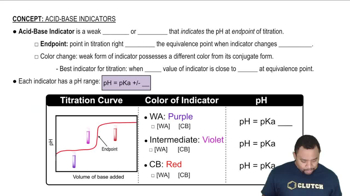
Acid-Base Indicators

Diprotic Acids

Diprotic acids are acids that can donate two protons (H+) per molecule during the titration process. They exhibit two distinct pKa values, corresponding to the two stages of dissociation. The titration curve for a diprotic acid will show two equivalence points, each associated with the loss of one proton, allowing for the determination of both pKa values from the curve.
추천 영상:
가이드 코스
04:40
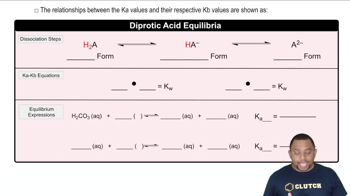
3 forms of Diprotic Acids