Ch.17 - Applications of Aqueous Equilibria
McMurry - Chemistry 8th Edition
McMurry8th EditionChemistryISBN: 9781292336145당신이 사용하는 게 아니라요?교과서 변경
17장, 문제 74

The ratio of HCO3- to H2CO3 in blood is called the 'bicarb number' and is used as a measure of blood pH in hospital emergency rooms. A newly diagnosed diabetic patient is admitted to the emergency room with ketoacidosis and a bicarb number of 10. Calculate the blood pH. Ka for carbonic acid at room temperature (37 degrees Celsius) os 7.9 x 10^-7).

검증된 단계별 안내
1
Step 1: Understand that the bicarb number is the ratio of bicarbonate ion (HCO3-) to carbonic acid (H2CO3). In this case, the bicarb number is 10, which means [HCO3-]/[H2CO3] = 10.
Step 2: Recognize that the Ka expression for carbonic acid (H2CO3) is Ka = [H+][HCO3-]/[H2CO3]. We can rearrange this to solve for [H+]: [H+] = Ka * [H2CO3]/[HCO3-].
Step 3: Substitute the bicarb number into the equation. Since [HCO3-]/[H2CO3] = 10, we can rewrite this as [H2CO3]/[HCO3-] = 1/10. Therefore, [H+] = Ka * 1/10.
Step 4: Substitute the given Ka value into the equation. Ka is given as 7.9 x 10^-7, so [H+] = 7.9 x 10^-7 * 1/10 = 7.9 x 10^-8.
Step 5: Use the definition of pH to calculate the blood pH. pH = -log[H+]. Substitute the calculated [H+] into this equation to find the pH.

비슷한 문제에 대한 검증된 영상 답변:

이 영상 해법은 위 문제에 도움이 된다고 튜터들이 추천한 것입니다.
영상 길이:
2m

주요 개념

질문에 올바르게 답하기 위해 반드시 이해해야 하는 핵심 개념들은 다음과 같습니다.

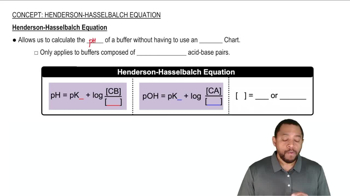
Henderson-Hasselbalch Equation

The Henderson-Hasselbalch equation relates the pH of a solution to the concentration of an acid and its conjugate base. It is expressed as pH = pKa + log([A-]/[HA]), where pKa is the negative logarithm of the acid dissociation constant (Ka). This equation is crucial for understanding how the ratio of bicarbonate (HCO3-) to carbonic acid (H2CO3) influences blood pH, especially in clinical settings.
추천 영상:
가이드 코스
02:40
Henderson-Hasselbalch Equation

Acid-Base Balance

Acid-base balance refers to the mechanisms the body uses to maintain the pH of blood and other fluids within a narrow range, typically around 7.35 to 7.45. This balance is achieved through buffers, respiratory control of carbon dioxide, and renal regulation of bicarbonate. In the context of ketoacidosis, the body's ability to manage acid-base balance is compromised, leading to significant changes in blood pH.
추천 영상:
가이드 코스
01:46
Balancing Acidic Redox Reactions

Carbonic Acid and Bicarbonate Buffer System

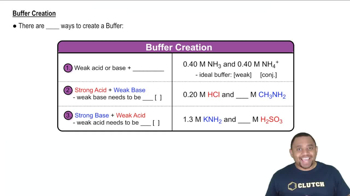
The carbonic acid (H2CO3) and bicarbonate (HCO3-) buffer system is a primary regulator of blood pH. It works by neutralizing excess acids or bases through reversible reactions. When the bicarb number is low, as in the case of ketoacidosis, it indicates a higher concentration of carbonic acid relative to bicarbonate, which can lead to a decrease in blood pH, making the blood more acidic.
추천 영상:
가이드 코스
03:04
Buffer Creation Methods