Ch.17 - Applications of Aqueous Equilibria
McMurry - Chemistry 8th Edition
McMurry8th EditionChemistryISBN: 9781292336145당신이 사용하는 게 아니라요?교과서 변경
17장, 문제 98

The titration of 0.02500 L of a diprotic acid solution with 0.1000 M NaOH requires 34.72 mL of titrant to reach the second equivalence point. The pH is 3.95 at the first equiva-lence point and 9.27 at the second equivalence point. If the acid solution contained 0.2015 g of the acid, what is the molar mass, pKa1, and pKa2 of the acid?

검증된 단계별 안내
1
Determine the moles of NaOH used at the second equivalence point by multiplying the volume of NaOH (in liters) by its molarity.
Since the acid is diprotic, the moles of NaOH used at the second equivalence point are equal to twice the moles of the acid. Use this relationship to find the moles of the acid.
Calculate the molar mass of the acid by dividing the mass of the acid by the moles of the acid.
Use the pH at the first equivalence point to find \( pK_{a1} \) using the relationship \( pK_{a1} = pH \) at the first equivalence point for a diprotic acid.
Use the pH at the second equivalence point to find \( pK_{a2} \) using the relationship \( pK_{a2} = pH \) at the second equivalence point for a diprotic acid.

비슷한 문제에 대한 검증된 영상 답변:

이 영상 해법은 위 문제에 도움이 된다고 튜터들이 추천한 것입니다.
영상 길이:
9m

주요 개념

질문에 올바르게 답하기 위해 반드시 이해해야 하는 핵심 개념들은 다음과 같습니다.

Titration and Equivalence Points

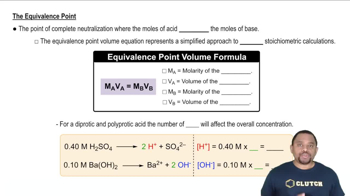
Titration is a quantitative analytical technique used to determine the concentration of a solute in a solution. In the context of a diprotic acid, there are two equivalence points during titration, where the amount of titrant added is stoichiometrically equivalent to the amount of acid present. The first equivalence point corresponds to the complete neutralization of the first proton, while the second equivalence point indicates the neutralization of the second proton.
추천 영상:
가이드 코스
03:06
Equivalence Point in Titration

pKa and Acid Strength

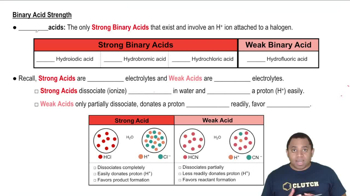
The pKa value is a measure of the strength of an acid in solution, representing the negative logarithm of the acid dissociation constant (Ka). For diprotic acids, there are two pKa values corresponding to the two dissociation steps. The lower the pKa, the stronger the acid, as it indicates a greater tendency to donate protons. The pH at the equivalence points can be used to calculate the pKa values of the acid.
추천 영상:
가이드 코스
03:51
Binary Acid Strengths

Molar Mass Calculation

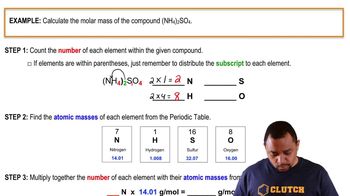
Molar mass is the mass of one mole of a substance, typically expressed in grams per mole (g/mol). To calculate the molar mass of the diprotic acid in this scenario, one can use the mass of the acid (0.2015 g) and the number of moles present at the equivalence point, which can be determined from the volume and concentration of the titrant used. This relationship allows for the determination of the molar mass based on the stoichiometry of the titration.
추천 영상:
가이드 코스
03:12
Molar Mass Calculation Example