Ch.18 - Thermodynamics: Entropy, Free Energy & Equilibrium
McMurry - Chemistry 8th Edition
McMurry8th EditionChemistryISBN: 9781292336145당신이 사용하는 게 아니라요?교과서 변경
18장, 문제 44

Predict the sign of the entropy change in the system for each of the following processes. (a) A solid sublimes. (b) A liquid freezes. (c) AgI precipitates from a solution containing Ag+ and I- ions. (d) Gaseous CO2 bubbles out of a carbonated beverage.

검증된 단계별 안내
1
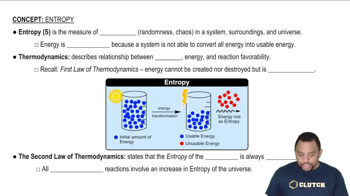
Step 1: Understand that entropy (S) is a measure of the disorder or randomness in a system. An increase in disorder corresponds to an increase in entropy, while a decrease in disorder corresponds to a decrease in entropy.
Step 2: For process (a), consider that sublimation is the transition from a solid directly to a gas. This transition involves an increase in disorder as the particles move from a fixed, ordered state to a more disordered gaseous state. Predict that the entropy change (ΔS) is positive.
Step 3: For process (b), freezing is the transition from a liquid to a solid. This transition involves a decrease in disorder as the particles become more ordered in the solid state. Predict that the entropy change (ΔS) is negative.
Step 4: For process (c), precipitation involves the formation of a solid from ions in solution. This process results in a decrease in disorder as the ions become part of a solid lattice. Predict that the entropy change (ΔS) is negative.
Step 5: For process (d), when gaseous CO2 bubbles out of a carbonated beverage, the gas is moving from a dissolved state in the liquid to a free gaseous state. This transition involves an increase in disorder. Predict that the entropy change (ΔS) is positive.

비슷한 문제에 대한 검증된 영상 답변:

이 영상 해법은 위 문제에 도움이 된다고 튜터들이 추천한 것입니다.
영상 길이:
3m

주요 개념

질문에 올바르게 답하기 위해 반드시 이해해야 하는 핵심 개념들은 다음과 같습니다.

Entropy

Entropy is a measure of the disorder or randomness in a system. In thermodynamics, it quantifies the number of ways a system can be arranged, with higher entropy indicating greater disorder. Processes that increase the number of microstates available to a system typically result in a positive change in entropy, while those that decrease microstates lead to a negative change.
추천 영상:
가이드 코스
02:46
Entropy in Thermodynamics

Phase Changes

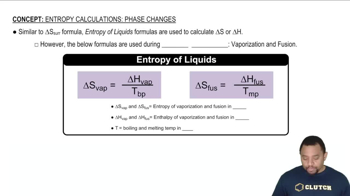
Phase changes refer to the transitions between solid, liquid, and gas states of matter. During these transitions, the arrangement and energy of particles change significantly. For example, sublimation (solid to gas) increases entropy due to the greater freedom of gas particles, while freezing (liquid to solid) decreases entropy as particles become more ordered.
추천 영상:
가이드 코스
01:46
Entropy in Phase Changes

Precipitation Reactions

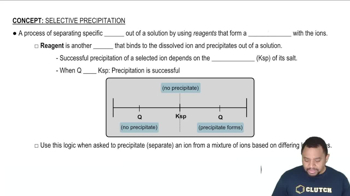
Precipitation reactions occur when ions in solution combine to form an insoluble solid, known as a precipitate. This process typically results in a decrease in entropy because the formation of a solid from ions in solution reduces the overall disorder of the system. The transition from a more disordered state (ions in solution) to a more ordered state (solid precipitate) reflects a negative change in entropy.
추천 영상:
가이드 코스
01:53
Selective Precipitation