Ch.19 - Electrochemistry
McMurry - Chemistry 8th Edition
McMurry8th EditionChemistryISBN: 9781292336145당신이 사용하는 게 아니라요?교과서 변경
19장, 문제 121d

A storm has knocked out power to your beach house, and you would like to build a battery from household items to charge your iPhone. You have the following materials. alum in the kitchen, which can be used to make a 1.0 M Al3+ solution bleach, which is a solution that is approximately a 1.0 M in ClO-aluminum foil, a platinum necklace and bologna, which can be used as a salt bridge (d) An iPhone requires 5.0 V for charging. Can this battery charge the phone? Explain.

검증된 단계별 안내
1
Identify the half-reactions for the materials available: Aluminum (Al) can be oxidized to Al³⁺, and ClO⁻ can be reduced to Cl⁻. Write the half-reactions: Al → Al³⁺ + 3e⁻ and ClO⁻ + 2H₂O + 2e⁻ → Cl⁻ + 4OH⁻.
Determine the standard reduction potentials (E°) for each half-reaction from a standard reduction potential table. The reduction potential for Al³⁺/Al is -1.66 V, and for ClO⁻/Cl⁻, it is +0.89 V.
Calculate the standard cell potential (E°cell) for the battery using the formula: E°cell = E°cathode - E°anode. Here, ClO⁻/Cl⁻ is the cathode and Al³⁺/Al is the anode.
Evaluate whether the calculated E°cell is greater than the required 5.0 V for charging the iPhone. If E°cell is less than 5.0 V, the battery cannot charge the phone.
Consider practical aspects such as the internal resistance of the battery and the efficiency of the salt bridge, which might further reduce the effective voltage output, impacting the ability to charge the phone.

비슷한 문제에 대한 검증된 영상 답변:

이 영상 해법은 위 문제에 도움이 된다고 튜터들이 추천한 것입니다.
영상 길이:
11m

주요 개념

질문에 올바르게 답하기 위해 반드시 이해해야 하는 핵심 개념들은 다음과 같습니다.

Electrochemistry

Electrochemistry is the branch of chemistry that deals with the relationship between electrical energy and chemical reactions. It involves the study of redox reactions, where oxidation and reduction occur simultaneously, allowing for the generation of electrical energy. Understanding electrochemical cells, including galvanic and electrolytic cells, is crucial for determining how to construct a battery from available materials.
추천 영상:
가이드 코스
01:40
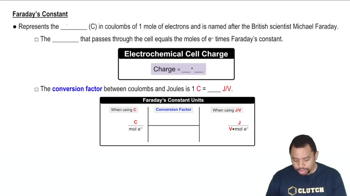
Faraday's Constant in Electrochemistry

Cell Potential and Voltage

The cell potential, or voltage, of an electrochemical cell is the measure of the energy difference between the reactants and products in a redox reaction. It is determined by the standard reduction potentials of the half-reactions involved. For a battery to charge a device like an iPhone, it must produce a voltage that meets or exceeds the required 5.0 V, which can be calculated based on the materials used and their respective half-reactions.
추천 영상:
가이드 코스
01:34
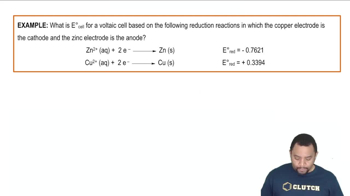
Standard Cell Potential Example

Salt Bridge Functionality

A salt bridge is a crucial component in electrochemical cells that maintains electrical neutrality by allowing the flow of ions between the two half-cells. It prevents the buildup of charge that would otherwise stop the reaction. In this scenario, using bologna as a salt bridge implies that it must facilitate ion transfer effectively, which is essential for sustaining the battery's operation and ensuring a continuous flow of current to charge the iPhone.
추천 영상:
관련 실천
교과서 질문

A mercury battery uses the following electrode half-reactions: (c) What is the effect on the cell voltage of a tenfold change in the concentration of KOH in the electrolyte? Explain..

454
views

교과서 질문

You are on your dream vacation at the beach when a major storm knocks out the power for days. Your cell phone is dead, and you want to make a battery to charge it. You find the following materials in the beach house. blue stone algaecide for pools, which can be used to make a 1.0 M Cu2+ solution alum in the kitchen, which can be used to make a 1.0 M Al3+ solution aluminum foil, copper wire, and bologna, which can be used as a salt bridge. (d) An iPhone requires 5.0 V for charging. Can this battery charge the phone? Explain.

310
views
교과서 질문

A storm has knocked out power to your beach house, and you would like to build a battery from household items to charge your iPhone. You have the following materials. alum in the kitchen, which can be used to make a 1.0 M Al3+ solution bleach, which is a solution that is approximately a 1.0 M in ClO-aluminum foil, a platinum necklace and bologna, which can be used as a salt bridge (b) What voltage can be generated?

290
views
교과서 질문

A storm has knocked out power to your beach house, and you would like to build a battery from household items to charge your iPhone. You have the following materials. alum in the kitchen, which can be used to make a 1.0 M Al3+ solution bleach, which is a solution that is approximately a 1.0 M in ClO-aluminum foil, a platinum necklace and bologna, which can be used as a salt bridge (a) What are the half-reactions and overall reaction in the battery?

203
views
교과서 질문

A mercury battery uses the following electrode half-reactions: (b) Calculate ∆G° (in kilojoules) and K at 25 °C for the cell reaction.

747
views