
Ch.21 - Transition Elements and Coordination Chemistry
McMurry - Chemistry 8th Edition
McMurry8th EditionChemistryISBN: 9781292336145당신이 사용하는 게 아니라요?교과서 변경
21장, 문제 21.137e

The complete reaction of 2.60 g of chromium metal with 50.00 mL of 1.200 M H2SO4 in the absence of air gave a blue solution and a colorless gas that was collected at 25°C and a pressure of 735 mm Hg. (e) When an excess of KCN is added to the solution, the color changes, and the paramagnetism of the solution
decreases. Explain.

검증된 단계별 안내
1
Identify the initial reaction: Chromium (Cr) reacts with sulfuric acid (H2SO4) to produce chromium sulfate (Cr2(SO4)3) and hydrogen gas (H2).
Recognize that the blue solution is likely due to the formation of a chromium(III) complex, such as [Cr(H2O)6]^{3+}.
Understand that the addition of an excess of KCN leads to the formation of a new complex, [Cr(CN)6]^{3-}, which is less paramagnetic.
Explain that the decrease in paramagnetism is due to the fact that the cyanide complex has a lower number of unpaired electrons compared to the initial chromium complex.
Conclude that the color change and decrease in paramagnetism are due to the formation of a different chromium complex with cyanide ligands, which alters the electronic structure and properties of the solution.

비슷한 문제에 대한 검증된 영상 답변:

이 영상 해법은 위 문제에 도움이 된다고 튜터들이 추천한 것입니다.

주요 개념

질문에 올바르게 답하기 위해 반드시 이해해야 하는 핵심 개념들은 다음과 같습니다.

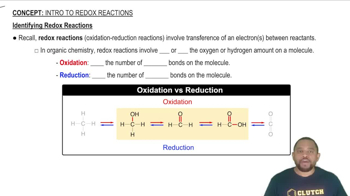
Redox Reactions

Redox reactions involve the transfer of electrons between substances, leading to changes in oxidation states. In the given reaction, chromium metal is oxidized while sulfuric acid is reduced, resulting in the formation of a blue solution and a colorless gas, likely hydrogen. Understanding the electron transfer is crucial for analyzing the chemical changes occurring in the reaction.
추천 영상:
가이드 코스
03:12
Identifying Redox Reactions

Paramagnetism

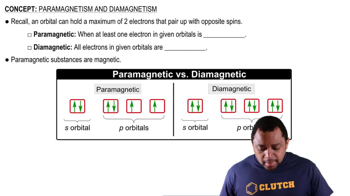
Paramagnetism is a form of magnetism that occurs in materials with unpaired electrons, which can be attracted by an external magnetic field. The presence of unpaired electrons in transition metal complexes, such as those formed with chromium, contributes to the solution's paramagnetic properties. The addition of KCN alters the electronic structure of the chromium complex, reducing the number of unpaired electrons and thus decreasing paramagnetism.
추천 영상:
가이드 코스
01:33
Paramagnetism and Diamagnetism

Complex Ion Formation

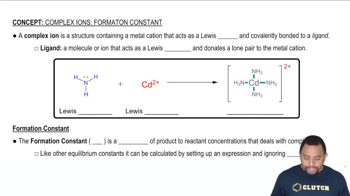
Complex ions are formed when metal ions coordinate with ligands, which are molecules or ions that can donate electron pairs. In this case, KCN acts as a ligand that binds to chromium ions in the solution, leading to the formation of a new complex. This interaction not only changes the color of the solution but also affects its magnetic properties, illustrating the significance of ligand interactions in coordination chemistry.
추천 영상:
가이드 코스
02:20
Complex Ions and Formation Constant
관련 실천
교과서 질문

In acidic aqueous solution, the complex trans-[Co(en)2Cl1]2+(aq) undergoes the following substitution reaction:

trans-[Co(en)1Cl2]+(aq) + H2O(l) → trans-[Co(en)2(H2O)Cl]2+(aq) + Cl–(aq)

The reaction is first order in trans-[Co(en)2Cl2]+(aq), and the rate constant at 25°C is 3.2×10⁻⁵ s–1.

(d) Is the reaction product chiral or achiral? Explain.

77
views
교과서 질문

Locate on the periodic table the transition elements with the following electron configurations. Identify each element.

(c) [Kr] 4d25s2

(d) [Xe] 4f36s2

91
views
교과서 질문

Locate on the periodic table the transition elements with the following electron configurations. Identify each element.

(a) [Ar] 3d74s2

(b) [Ar] 3d54s1

98
views
교과서 질문

In acidic aqueous solution, the complex trans-[Co(en)2Cl1]2+(aq) undergoes the following substitution reaction:

trans-[Co(en)2Cl1]+(aq) + H2O(l) → trans-[Co(en)2(H2O)Cl]2+(aq) + Cl–(aq)

The reaction is first order in trans-[Co(en)2Cl2]+(aq), and the rate constant at 25°C is 3.2×10⁻⁵ s–1.

e. Draw a crystal field energy-level diagram for trans-[Co(en)2Cl2]+ that takes account of the fact that Cl– is a weaker-field ligand than ethylenediamine.

82
views
교과서 질문

Spinach contains a lot of iron but is not a good source of dietary iron because nearly all the iron is tied up in the oxalate complex [Fe(C2O4)3]3-.

(d) Draw the structure of [Fe(C2O4)3]3-. Is the complex chiral or achiral?

83
views
교과서 질문

Look at the location in the periodic table of elements A, B, C, and D. What is the electron configuration of the transition metal in each of the following ions?

(c) C3+

(d) DO42-

104
views