Milk of magnesia, a widely used antacid, is an aqueous suspension of Mg1OH22. How would you prepare Mg1OH22 from magnesium metal?
검증된 단계별 안내
1
Start by understanding that magnesium hydroxide, Mg(OH)_2, can be prepared by reacting magnesium metal with water, but this reaction is not straightforward due to magnesium's protective oxide layer.
To facilitate the reaction, magnesium metal is often reacted with an acid to form a soluble magnesium salt, such as magnesium chloride (MgCl_2), which can then be converted to magnesium hydroxide.
React magnesium metal with hydrochloric acid (HCl) to form magnesium chloride (MgCl_2) and hydrogen gas (H_2) according to the equation: \[ \text{Mg (s) + 2 HCl (aq) \rightarrow MgCl_2 (aq) + H_2 (g)} \]
Once you have magnesium chloride in solution, add a strong base like sodium hydroxide (NaOH) to the solution. This will precipitate magnesium hydroxide according to the equation: \[ \text{MgCl_2 (aq) + 2 NaOH (aq) \rightarrow Mg(OH)_2 (s) + 2 NaCl (aq)} \]
Filter the precipitated magnesium hydroxide from the solution, wash it to remove any impurities, and then suspend it in water to create milk of magnesia.
비슷한 문제에 대한 검증된 영상 답변:
이 영상 해법은 위 문제에 도움이 된다고 튜터들이 추천한 것입니다.
영상 재생:
0 댓글
주요 개념
질문에 올바르게 답하기 위해 반드시 이해해야 하는 핵심 개념들은 다음과 같습니다.
Metal Reactivity and Oxidation
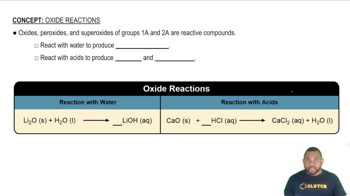
Magnesium is a highly reactive metal that readily oxidizes when exposed to air or moisture. In the preparation of magnesium hydroxide, magnesium metal reacts with water, leading to the formation of magnesium oxide and hydrogen gas. Understanding this reactivity is crucial for predicting the products of the reaction and ensuring safe handling of magnesium.
Magnesium hydroxide, Mg(OH)2, is formed when magnesium oxide reacts with water. This process involves the dissolution of magnesium oxide in water, where it interacts with water molecules to produce magnesium hydroxide. Recognizing the conditions under which hydroxides form is essential for synthesizing compounds in aqueous solutions.
Stoichiometry involves the calculation of reactants and products in chemical reactions based on balanced equations. To prepare Mg(OH)2 from magnesium metal, one must understand the molar ratios of magnesium, water, and the resulting hydroxide. This concept is vital for determining the quantities needed for the reaction and ensuring complete conversion of reactants.