Ch.3 - Mass Relationships in Chemical Reactions
McMurry - Chemistry 8th Edition
McMurry8th EditionChemistryISBN: 9781292336145당신이 사용하는 게 아니라요?교과서 변경
3장, 문제 77b

How many grams of each product result from the following reactions, and how many grams of which reactant is left over? (b)

검증된 단계별 안내
1
insert step 1
insert step 2
insert step 3
insert step 4
insert step 5

비슷한 문제에 대한 검증된 영상 답변:

이 영상 해법은 위 문제에 도움이 된다고 튜터들이 추천한 것입니다.
영상 길이:
7m

주요 개념

질문에 올바르게 답하기 위해 반드시 이해해야 하는 핵심 개념들은 다음과 같습니다.

Stoichiometry

Stoichiometry is the branch of chemistry that deals with the quantitative relationships between the reactants and products in a chemical reaction. It involves using balanced chemical equations to calculate the amounts of substances consumed and produced. Understanding stoichiometry is essential for determining how many grams of products are formed and how much of the reactants remain after the reaction.
추천 영상:
가이드 코스
01:16
Stoichiometry Concept

Limiting Reactant

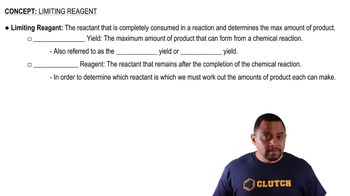
The limiting reactant is the substance that is completely consumed first in a chemical reaction, thus determining the maximum amount of product that can be formed. Identifying the limiting reactant is crucial for calculating the amounts of products produced and any excess reactants left over. This concept helps in understanding how reactants interact and the efficiency of the reaction.
추천 영상:
가이드 코스
01:30
Limiting Reagent Concept

Molar Mass

Molar mass is the mass of one mole of a substance, typically expressed in grams per mole (g/mol). It is used to convert between the mass of a substance and the number of moles, which is essential for stoichiometric calculations. Knowing the molar masses of reactants and products allows for accurate calculations of how many grams of each substance are involved in a reaction.
추천 영상:
가이드 코스
02:11
Molar Mass Concept
관련 실천
교과서 질문

How many grams of each product result from the following reactions, and how many grams of which reactant is left over? (a)

311
views

교과서 질문
Acetic acid (CH3CO2H) reacts with isopentyl alcohol (C5H12O) to yield isopentyl acetate (C7H14O2), a fragrant substance with the odor of bananas. If the yield from the reaction of acetic acid with isopentyl alcohol is 45%, how many grams of isopentyl acetate are formed from 3.58 g of acetic acid and 4.75 g of isopentyl alcohol? The reaction is CH3CO2H + C5H12O ---> C7H14O2 + H2O
2262
views
교과서 질문
Sodium azide (NaN3) yields N2 gas when heated to 300 °C, a reaction used in automobile air bags. If 1.00 mol of N2 has a volume of 47.0 L under the reaction conditions, how many liters of gas can be formed by heating 38.5 g of NaN3? The reaction is
1444
views
교과서 질문

Limestone (CaCO3) reacts with hydrochloric acid according to the equation CaCO3 + 2 HCl ---> CaCl2 + H2O + CO2. If 1.00 mol of CO2 has a volume of 22.4 L under the reaction conditions, how many liters of gas can be formed by reaction of 2.35 g of CaCO3 with 2.35 g of HCl? Which reactant is limiting?

6286
views
1
rank
교과서 질문
Hydrogen and chlorine react to yield hydrogen chloride: H2 + Cl2 ¡ 2 HCl. How many grams of HCl are formed from reaction of 3.56 g of H2 with 8.94 g of Cl2? Which reactant is limiting?
2471
views
교과서 질문

How many grams of the dry-cleaning solvent 1,2-dichloroethane (also called ethylene chloride), C2H4Cl2, can be prepared by reaction of 15.4 g of ethylene, C2H4, with 3.74 g of Cl2?

702
views