Ch.3 - Mass Relationships in Chemical Reactions
McMurry - Chemistry 8th Edition
McMurry8th EditionChemistryISBN: 9781292336145당신이 사용하는 게 아니라요?교과서 변경
3장, 문제 82

If 1.87 g of acetic acid (CH3COOH) reacts with 2.31 g of isopentyl alcohol (C5H12O) to give 2.96 g of isopentyl acetate (C7H14O2), what is the percent yield of the reaction?

검증된 단계별 안내
1
Identify the balanced chemical equation for the reaction: \[ \text{CH}_3\text{COOH} + \text{C}_5\text{H}_{12}\text{O} \rightarrow \text{C}_7\text{H}_{14}\text{O}_2 + \text{H}_2\text{O} \]
Calculate the molar mass of acetic acid (CH3COOH) and isopentyl alcohol (C5H12O) using the periodic table.
Determine the moles of acetic acid and isopentyl alcohol by dividing their given masses by their respective molar masses.
Identify the limiting reactant by comparing the mole ratio from the balanced equation to the moles calculated.
Calculate the theoretical yield of isopentyl acetate (C7H14O2) using the moles of the limiting reactant and convert it to grams. Then, use the formula for percent yield: \[ \text{Percent Yield} = \left( \frac{\text{Actual Yield}}{\text{Theoretical Yield}} \right) \times 100 \]

비슷한 문제에 대한 검증된 영상 답변:

이 영상 해법은 위 문제에 도움이 된다고 튜터들이 추천한 것입니다.
영상 길이:
3m

주요 개념

질문에 올바르게 답하기 위해 반드시 이해해야 하는 핵심 개념들은 다음과 같습니다.

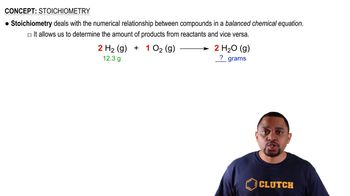
Stoichiometry

Stoichiometry is the calculation of reactants and products in chemical reactions based on the balanced chemical equation. It involves using mole ratios derived from the coefficients of the balanced equation to determine how much of each substance is consumed or produced. Understanding stoichiometry is essential for determining theoretical yields and comparing them to actual yields in a reaction.
추천 영상:
가이드 코스
01:16
Stoichiometry Concept

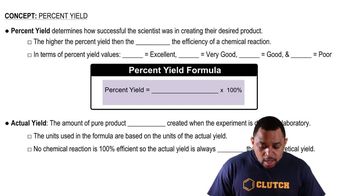
Percent Yield

Percent yield is a measure of the efficiency of a chemical reaction, calculated by comparing the actual yield of a product to the theoretical yield. It is expressed as a percentage and is calculated using the formula: (actual yield / theoretical yield) × 100%. This concept is crucial for evaluating how well a reaction proceeds and identifying any losses that may occur during the process.
추천 영상:
가이드 코스
03:09
Percent Yield in Reactions

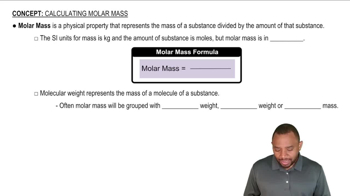
Molar Mass

Molar mass is the mass of one mole of a substance, typically expressed in grams per mole (g/mol). It is calculated by summing the atomic masses of all atoms in a molecule. Knowing the molar masses of reactants and products is vital for converting between grams and moles, which is necessary for stoichiometric calculations and determining theoretical yields in chemical reactions.
추천 영상:
가이드 코스
02:11
Molar Mass Concept
관련 실천
교과서 질문

The reaction of tungsten hexachloride (WCl6) with bismuth gives hexatungsten dodecachloride (W6Cl12).

WCl6 + Bi → W6Cl12 + BiCl3 Unbalanced

(b) How many grams of bismuth react with 150.0 g of WCl6?

561
views
교과서 질문
Acetic acid (CH3CO2H) reacts with isopentyl alcohol (C5H12O) to yield isopentyl acetate (C7H14O2), a fragrant substance with the odor of bananas. If the yield from the reaction of acetic acid with isopentyl alcohol is 45%, how many grams of isopentyl acetate are formed from 3.58 g of acetic acid and 4.75 g of isopentyl alcohol? The reaction is CH3CO2H + C5H12O ---> C7H14O2 + H2O
2262
views
교과서 질문
Sodium azide (NaN3) yields N2 gas when heated to 300 °C, a reaction used in automobile air bags. If 1.00 mol of N2 has a volume of 47.0 L under the reaction conditions, how many liters of gas can be formed by heating 38.5 g of NaN3? The reaction is
1444
views
교과서 질문
Cisplatin [Pt(NH3)2Cl2], a compound used in cancer treat-ment, is prepared by reaction of ammonia with potassium tetrachloroplatinate: K2PtCl4 + 2 NH3 ----> 2 KCl + Pt(NH3)2Cl2 How many grams of cisplatin are formed from 55.8 g of K2PtCl4 and 35.6 g of NH3 if the reaction takes place in 95% yield based on the limiting reactant?
1709
views
교과서 질문

The reaction of tungsten hexachloride (WCl6) with bismuth gives hexatungsten dodecachloride (W6Cl12).

WCl6 + Bi → W6Cl12 + BiCl3 Unbalanced

(a) Balance the equation.

765
views
교과서 질문
If 3.42 g of K2PtCl4 and 1.61 g of NH3 give 2.08 g of cispla-tin (Problem 3.81), what is the percent yield of the reaction?
603
views